22 February 2009

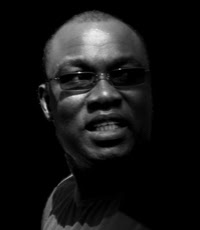
The Phoenix by A. Igoni Barrett

Due north of the conflux of the great rivers Niger and Benue lies a plateau inhabited by many tribes and village kingdoms. For as far as the eye can travel unimpeded the green plains of this land roll on gently, so level in parts that the storm waters stand nonplussed for a slope to run off. A cluster of hills span the eastern horizon of the fertile tableland, their distant peaks daily lost in morning mists until the sun’s rubicund face emerges from their midst. Giant-sized outcrops of blue-black marble dot the landscape like broken eggshells. A sweet-smelling carpet of succulent-stemmed elephant grass dances slowly in the perpetual breeze of those rarefied heights. Furlongs separate the few trees that rise from the earth, each one shorter than a man and with near-leafless branches so intertwined that snakes dangle from them like macabre festoons, fatally ensnared. A thin trail from the far hills meanders through this land—now a sludgy footpath, then the treacherous currents of the muddy River Mada. From its riverbed net traps dredge up finned relics of the dinosaur age. The pastoral calm of this sprawling land is now and again splintered by the mating cries of wild guinea fowls. The mighty elephant once strode these plains, as did gorillas, ostriches and white missioners: of them all what remains is bleached bone.

This was the land of Tartius Abrachius’ birth, the Shangri-La that he loved with a savage passion—until he lost both arms to the swing of a machete that had coveted his life. He was lucky: he was the only survivor of a party of school children whose pearl-clear laughter was cut short in an ambush mounted by warriors of a neighbouring tribe. This slaughter spelt the deathblow to a decades-old truce between centuries-old enemies. Reprisals followed, and were endlessly reciprocated, and then succeeded by powwows that served no purpose other than as interregna during which the belligerents—exchanging the sword for the scythe—gathered in their harvests. By the time the conflict had exhausted its fuel of angry young men, Tartius Abrachius was in the prime of manhood.

In spite of his handicap, which had lain heavy on him, and had nearly broken his spirit (both arms lopped off at the elbow!), Tartius Abrachius had from the outset refused to resign himself to the sad fate of a beggarly existence, forever dependent on the pity of strangers. He had shrugged off the fears of family and friends and had chosen a trade. He had learnt it well, and with resourcefulness he compensated for his physical shortcomings. Tartius Abrachius was an itinerant tailor

Two days after the termination of his tailoring apprenticeship Tartius Abrachius, again scorning the easy advice of kith and kin, abandoned the scene of his woe for the Big City. It wasn’t an easy decision: the beauty of those verdant plains tugged at him like an umbilical cord, and almost turned endurable the memory of his loss.

Plying his trade in the Big City, Tartius Abrachius was at first a novelty, and attracted custom only on the strength of this fact. For, at the sight of the armless man with the headless horse-shape of a sewing machine riding on one shoulder, and the twill cap of his trade set on his head at an angle decidedly rakish—as if he had hands and they were thrust into his pockets; at the sight of this curious figure, Pygmy-short and as slim as a starved tomcat, his features genial and untouched by his misfortune, the spring in his step disavowing worry; at the sight of Tartius Abrachius the housewives abandoned their chores and trooped out of their houses with armfuls of clothing that suddenly required the sartorial touch. And while he snipped and stitched away these busybodies hovered about, ostensibly for the gossip. He did not disappoint: he regaled them with tales blatantly traitorous to his own sex and astounded their sense of wonder with the ease with which he executed the ‘sleight of feet’ involved in wielding scissors and threading needles.

Over time, seeing the quality of his work, and coming to regard the moments spent in his company as respite from the trap of domestic monotony, he became a favourite amongst the housewives of the Okobaba and Makoko slums, and made a good living off their loneliness.

In the split-second before Tartius Abrachius was forever parted from his arms they had been outstretched, this following a mock throw-in to demonstrate the finer points of getting one’s weight behind a hurled soccer ball. He was a soccer-fiend. At an age when his counterparts were aspiring no higher than to become cartoon characters, he had decided upon his future profession. And, at a precocious twelve years of age, he had put the finishing touches to a work plan for achieving his goals. But that was the year that destiny intervened, and as no contingency plan of man can salvage a dream that the fates have repudiated, he watched his ambition shrivel and die.

Second to none on Tartius Abrachius’ blueprint for world domination was physical training, specifically running. Born in a land whose span intoxicated the wild stallion in man, running was an activity for which the opportunity and incentive was never lacking. And Tartius Abrachius could run. When he sucked in his breath and dove headlong at the world it was no exaggeration to aver that none in ten villages could touch his coattails. He ran like Atalanta reborn: with supreme focus, supreme confidence, and the effortlessness of a falling leaf. He was beautiful to watch, and he was beautiful every day, his slim form cutting swathes through the sea of emerald bushes that caressed his legs with delicate slashes, and swayed in obeisance to his dedication.

Though on that fateful day unable to do anything for his arms, instantaneous to the blow his feet unfurled their wings and bore him away like a billet-bound bullet, thus saving his life. That, however, was the last time he ever ran those fields.


Tartius Abrachius, with his sewing machine on his shoulder and sauntering even in the heat of midday, raised his hand to scratch his nose—and saw the stump. He wrinkled his nose and smiled wryly. Even after all this time he still wasn’t accustomed to his lack of hands, and the situation was not helped by the fact that he could feel them dangling at the end of nothingness; he could feel every muscle spasm and flex of a finger, and the weight of fingernails growing untrimmed, and the itch in his palm whenever money was expected. He jabbed at his nose with the stump and turned his thoughts to football.

His dream, years dead, had been transfigured from beyond the grave and now thrust itself once again upon his consciousness. The rolling away of the stone from the door of the sepulchre, so to speak, had begun with a football match he had stumbled upon. Mrs. Akoy, a friend and customer, had recently lost her youngest daughter, and it was while on the way to her house to offer his condolences that he came upon a grass oasis in that desert of brick and corrugated iron. There he experienced a vision: he beheld a group of disabled men engaged in the Beautiful Game. On sighting him they had let out whoops of brotherhood, and had invited his participation. He declined, seeing as the house of the bereaved was within sight of the field. But, after verifying that they were a club, and that some of their members played professionally, and also that they convened on that field of dreams on the same day of every week, he promised to put in an appearance at their next meet. That was today.

Tartius Abrachius’ feet trembled at the thought of kissing the round leather. It had been years: years of stagnation, years of no passion. Yet there were others like him out there playing the game, living his dream. He would reclaim it. Maybe not the major leagues, the big clubs—but then again why not? Prosthetics: an addition to his diction since moving to the Big City. He had been saving up towards that new goal, though what he had managed to gather so far was still only a drop in the ocean. But no matter—the important thing was football. Maybe he would make the Paralympics, or, why not even the first armless man to play in La Liga. The Guinness Book of Records. A blessing in disguise. But the important thing was football. Tartius Abrachius’ feet trembled.

‘Thief! Olé! Hold him o—please hold him! Olé!’

A shape hurtled past Tartius Abrachius. The woman who had raised the alarm, the victim he presumed, was running towards him, her efforts hampered by overweight and a wrapper that kept coming undone. Her cries had sent some pedestrians in hot pursuit of the culprit, with more joining the chase as they comprehended the situation. Then the woman, still screaming entreaties garnished with imprecations, fell flat on her face.

‘I am not disabled—I just have no arms,’ Tartius Abrachius whispered; then he flung aside his sewing machine and set out after the crowd that had formed on the thief’s tail.

At his first step there was an explosion in his head; then a strange calm descended on him. But, with no arms to steer with, he ran awkwardly, like a flightless bird. It was the same way he had run on that day, the last day he had run. His spirits began to flag. As his calf-muscles bunched in preparedness for pulling up, he remembered his soccer game. He exploded forward.

With the wind in his face Tartius Abrachius recalled the wide-open fields of his childhood and the velvet softness of the earth beneath the feet and the perfume of crushed grass, and his ambitions—and he ran. His legs pistoned like their joy had suffered no hiatus and tears squeezed from his eye corners and got sucked into the whoosh of his slipstream. He ran.

The crowd ahead had become a mob, but when the stragglers heard the rapid-fire slap of feet from behind them, and turned, and dove out of the way, and shouted, the mob parted to let Tartius Abrachius through. As he streaked through their centre, like a bullet train through a tunnel, they let out a roar of approbation and followed him. Tartius Abrachius, running like a banished demon, soon left their shouts behind. Pictures flashed through his head of him in La Liga, tearing past the last defender, bearing down on the goalkeeper. . . Tartius Abrachius ran like his life depended on it.

The quarry, fewer paces ahead of Tartius Abrachius than the mob was behind him, threw a wild look over his shoulder and saw that Tartius Abrachius was gaining. His face held a plea, but Tartius Abrachius, blind to it on account of the dream that hovered before his eyes, tucked in his chin and ate up the distance. The man, on his last legs, reached a road junction and dove into it. Tartius Abrachius ran. He turned the corner just in time to see the man veer into an alley. He ran like he had never run before—he ran to catch a dream. As he approached the alley entrance something on the ground caught his eye. Then he heard a hubbub of angry voices approaching from the road opposite the alley, and, so as not to be robbed of his prize, increasing his speed with an effort that caught his chest in a vice grip, he ran headlong into the arms of a second mob.

‘Thief! Olé!’ the tapestry of inflamed faces chanted at Tartius Abrachius, and as he grinned in breathless bewilderment, unable to speak for the pain in his chest, they plonked two tyres over his head and, dousing him in petrol, set him alight.

‘Tailor!’ he screeched, before the flames engulfed him.

The first mob arrived just as the charred mass that was once Tartius Abrachius gave the last whirl of its dance of death and collapsed to the ground, never to rise again. They joined their cheers to those they had met. Then the woman who had given the alarm appeared. Her stolen purse was thrust into her hands. They had found it at the spot where the thief was caught.

‘But that isn’t the thief,’ she said, looking about fearfully.

‘Na him—how you know—e no get face again!’ came the angry replies.

‘But this person doesn’t have hands. The thief had hands—how else did he grab my purse?’ the woman argued, with irrefutable logic.

The mob fell silent, staring at the smouldering corpse. Someone burst into a retching fit. Another remembered that he had left his shop untended. Then, in little pockets, the mob disintegrated, leaving behind Tartius Abrachius in the ashes of his dreams.


The Phoenix appears in From Caves of Rotten Teeth published by Daylight Media, Port Harcourt, Nigeria.

Copyright A. Igoni Barrett 2005.


A. Igoni Barrett

A. Igoni Barrett is the author of one book, a collection of short stories titled From Caves of Rotten Teeth. A story from this collection emerged winner of the 2005 BBC World Service short story competition.

His short fiction has been published in Eclectica, Guernica, Mississippi Crow, Istanbul Literary Review and Stickman Review.

He lives in Lagos, Nigeria, where he works as an editor with Farafina magazine.


21 February 2009

Robin Hood & The President's Birthday Bash by Masimba Musodza

Recent issues of Hansard said his full name was the Rt. Hon. Severus Tichadya Nhomi, MP, Governor and Resident Minister of Mashonaland South Province. What they did not say was that he was a fat, squat individual who could hide a mobile phone in the rolls of adiposity that quivered under his arms. That and much more.

He frowned, stood against the cabinet with what he probably imagined was the right level of superciliousness with which to receive the younger, affable man who had stepped in to his office and introduced himself as Thaddeus Chibanda, a member of the Fund-Raising Committe for this year's President's Birthday Bash. He had also mentioned that he was based at Kaguvi Building, which was like an American official mentioning to a politician that he was based at Langley.

"I thought fund-raising for the bash in this area fell under my office," Nhomi drawled.

"Normally, it would, Comrade Resident Minister," Chibanda smiled. "However, you have only been in the office barely a week, and it was decided at the highest level that this year, someone else would handle it."

Nhomi decided that there was an unacceptable and irritating lack of respect on the part of the younger man. The fact that he was part of an organisation that would not hesitate to relocate him to the bottom of Lake Chivero with all the other dissidents might have something to do with it. He decided to show the little mofo that this was his office by ignoring the letters of introduction Chibanda had placed on the desk.

"But of course," Nhomi replied, forcing a smile on his Mick Jagger lips. "It is most reassuring that the highest level is concerned with us provinicials."

Chibanda leaned back expansively in the chair, and looked at Nhomi as at a social inferior on whose wife he had exercised his droit du signeur the night prior. Nhomi scowled, outraged as if he had in fact done just that.

"Right, Nhomi," Chibanda said, leaning forward in a business-like manner. The governor started at the disrespectful form of address, but Chibanda went on. "The reason they sent someone from Kaguvi is that it is known that you have been generously supplied by a bunch of white farmers who hope that you may help them get their farms back in this new GNU dispensation."

Chibanda grinned as the colour drained from Nhomi's face. Then, he grew stern. "To cut to the chase, the catalogue of presents that you have received covers a large portion of your province's quota."

Nhomi's response was incoherent at first as he struggled to stop his massive lips and jowls from quivering. He tried a laugh. "I hope, comrade, you don't think that I was planning to keep all those goodies for myself?"

Chibanda looked indignant. "No, of course not!" he cried.

"I was going to donate some to the President's Bash," Nhomi declared, moving closer to Chibanda as if that would convince him of his sincerity.

"Some?" Chibanda asked.

Nhomi fumbled again before blurting, "Well, I thought I could the rest for the local bash!"

Chibanda stared at him. "Caviar, expensive wines? Hardly the sort of spread I would put out for a bunch of peasants."

"Oh, come now!" said Nhomi. "It's the President's Bash, why not celebrate in style if we can afford it? And we can, because someone else pays for it."

"Someone else pays for all of it," said Chibanda. "Tell me, Governor, doesn't it prick your conscience that we are gathering all this rich food and yet as a government we have presided over growing misery for the common person?"

It was Nhomi's turn to look astonished. He eyed the younger man warily. It had to be a trick question, a test for orthodoxy.

"Well, that is not quite true, you know," Nhomi answered. "The Bash has to be extravagant, to show our detractors and imperialist enemies that Zimbabweans can still celebrate our living heroes in style, despite the illegal sanctions they have slapped on us. That is why I want the villagers to eat caviar and sip champagne, so the world can see that we are proud of our leader, President Robert Gabriel Mugabe!"

Chibanda smiled approvingly. Then, a question occurred to him. "Hey, what about the white farmers who gave you the goodies?"

Nhomi started, he had forgotten about them. Then, he shrugged them off. "Rhodesian pigs!" he muttered. "They will have to accept the irreversability of the Land Reform Programme!"

He wondered if he should mention that he had also received up to US$100000 as protection money, insurance against further farm seizures. If this C.I.O. did not know about it, it was a risk worth taking not to say anything.

"Tell you what," Chibanda was saying. "I will have a good report about you when I get back to Harare. The big people listen to what I say, and you will notice the difference in your life, my friend."

"Well, we all try to do what we can for the State," Nhomi said, his bloated features glowing with pleasure.

"No, I mean it," said Chibanda. "And let me show you what we can do for those who work well for us. I am going to send someone round with fuel coupons."

"Fuel coupons?" Nhomi whispered, and you could see he was practically slobbering.
"That is just a starter," Chibanda chuckled, rising. "If your kids are not already studying abroad, I think you ought to pick a university with them tonight, then call me."

This time, Nhomi could not control himself. He clapped his hands, and clasped them for a moment as if he was experiencing orgasm.

"Let me give you my card,"Chibanda offered. "Now, I really have to be off. Do you think you can sort out the handover right away?"

"Of course, sir!" Nhomi roared. He ambled over to his desk and drated a letter, stamped it, and handed it to Chibanda. "My servants will help you load it all."


When Nhomi got back to his newly acquired ranch on the outskirts of the provinical capital, he was told by his nephew,a kept relative who acted as a sort of personal aide, that the C.I.O. had helped themselves to not only the stuff the whites had brought, but the coldroom's entire contents, which included not only several cattle, but game and poultry. They had also seized the grain which Nhomi had hoped to sell on the black market in Harare for American dollars.

"And you let them?" Nhomi blurted, his breathing laboured.

"They were C.I.O!" the nephew pointed out. "I am not taking a bullet for oysters and prawns and wine! I would have let them bang my wife if they had asked to."

Nhomi would have done the same. In fact, he had on a number of occasions. One of his kids bore a striking resemblance to a senior Politiburo member.

"They left a note, uncle," the nephew said.

Nhomi shook the image of the C.I.O. taking turns with his niece by marriage and frowned at the offered envelope. He ripped it open with fat, trembling hands. The look of rage on his pudgy features morphed first in to one of incredulity, then dismay.


Governor Nhomi

As your nephew may have told you by now, we cleaned you out. If you make further enquiries, you will be able to confirm that my name is not Chibanda and I am not with the President's Office.

The stuff that we have taken from your larder will be given to the hungry villagers in the province. I doubt that the Fund-raising Committee will miss it very much, as they already have plenty. But the oridinary people have nothing. You shouldn't miss it very much either as you have enough cholesterol in you to paint the ZANU-PF Headquarters and the nearby Sheraton Hotel.

Say Happy Birthday to old Bob for me!Yours,

R.Hood, Zim-style.


As the world swirled around him and the blood thudded in his ears as it coursed through his body at accelerated speeds, Governor Nhomi thought he heard his nephew say that the Governor of Matebeleland Central, his closest friend in the party, wished to speak to him urgently on the phone.


Robin Hood & The President's Birthday Bash was written by Masimba Musodza.


Copyright Masimba Musodza 2009.

I was born in 1976, as independence and all it offered to an erstwhile disenfranchised Black majority dawned on the country now known as Zimbabwe. I was educated at Avondale Primary School, Harare, and St Mary Magdalene's High School in Nyanga. Then I went to Film School, majoring in Screenwriting and Directing. So, while I am only just emerging in the literary world, I have been a writer for film and television for a while now.

I am the author of The Man who turned into a Rastafarian, an anthology of short-stories. A novel is due to published before the end of the year. I am now working on a ChiShona language novel that I think will push and redefine the boundaries of the genre. I also write essays of interest to adherents of the Rastafarian Faith.


14 February 2009

With Leticia by Emmanuel Sigauke

I bumped into Leticia on Bank Street, where she was almost hit by a car as she ran across to greet me. She shouted curses after the speeding car, but when she turned to me, she had calmed, like nothing had happened. She dodged my hug and offered a hand which I shook gratefully.

“I always see you here. Do you work somewhere close?” she asked.

“I work at Sales House,” I said, noticing that she was still ugly, which is why I had once thought I could have her in high school.

“Sales what?” she asked, and before I could answer, she started laughing, an honest, toothy laugh, like she could just die on the pavement and go to heaven. At first I pretended to be confused; then I started laughing too. It was just a wonder looking at her teeth, which reminded you of things that dug things, but again, I had once loved them.

My eyes focused on her forehead, which was creased when she laughed. I stopped laughing and decided to cough. That’s when she said: “I always knew you would fail.”

“Fail what”?

“Now you are going to lie to me and say you passed A-Level? News already traveled and it’s been what? Seven months and you are already talking about ‘I work at Sales Houses’. It was always clear you would end up somewhere like that.”

“How did you know that I would fail though?” I said.

“Do I even have to explain that? Who went to the front of the class and wrote that nonsense on the board?” she asked, her voice thicker like she had phlegm to clear.

“What did I write on the board?” I said, moving closer to her, to let people walk freely around us.

“Remember, in class, waiting for the teacher?”

“Slap me or something, please,” I said, leaning even closer to her and feeling the softness of her sweater.

She laughed again, her voice splintering, as if the laughter had decided to turn into a cough. “Don’t tell me you already forgot.”

“I’m serious; I’ve no clue,” I said.

She didn’t believe me. The doubt was in her eyes, which were her main asset. They were wide and slanted. Big. Perhaps she was talking about that embarrassing incident in Literature class, where I had mispronounced the word querulous and the teacher laughed at me for five minutes and the class laughed for five days.

“I don’t know about that one,” she said. “Remember, I didn’t study English. I did---.”

“Geography, Shona, and History, I know.” I said, hoping that she would not pursue that matter further.

“So what happened in Lit class? How exactly did you pronounce the word?”

“Pretend I didn’t mention it,” I said. “Just tell me about this thing.”

She tilted her head and looked at me sideways, as if she was sizing me up for something. I liked that look, actually, with lips pushed forward a bit like a ripe wound.

“What’s crazy is Chari thought you were funny, like some kind of class hero,” she said.

Chari, the class monitor, had thought I was funny? How? He was the funny one, not me.

At that moment the image of a class dying with laughter while Chari and I danced in the front came flashing back, flitted away….then came back. Oh, that? She was silly.

“Why would you even think about that? It’s been...let's see...Seven months?”

“You asked me how I knew you would fail,” she said, her lips getting ready to release another guffaw. But they retracted and she said, “I knew you would remember.”

We had now resumed walking. I knew where I was going. And if she wanted to go with me, well, that was fine too. When we met I thought I saw that she had been going in the opposite direction, but …oh well. I walked faster, weaving my way through the lunch crowd. She kept up with me, still coughing out brief laughs.

“So what’s your point with all this—the laughter and all?” I said, slowing down.

“Just look where you are now. You caused this to yourself, that’s what you did,” she said. The breeze of her laughter swept her so close to me that her chest brushed against my shoulder. I felt momentary warmth like there was nothing to worry about in the world. Walking with her at that moment felt good, despite the laughter.

“Look where you are now,” she said again.

“Where am I?”

“For someone who was absolutely certain about going to university, it is just interesting to see that—.”

“What you don’t realize is I love my job and might become a manager soon,” I said.

But her laughter rose again, and she even went in front, turned to face me as she walked backwards. I stopped, to give her a signal that we didn’t have to continue walking.

“I’m not bothered by the fact that you didn’t get enough points to enter the university, but just seeing you here, which is nowhere close to UZ, cracks me up, especially since you’re the one who sung about it and made fun of everybody.”

She waited for a reaction, and when I didn’t give one she said, “Mr. Genius from the village. What was that place you came from again, where you read in the caves?”

No, she was taking this too far. I resumed walking and it didn’t sound like she was following me. I turned and saw that her laughter had overcome her again and she bent like one about to throw up. So now I had to wait for her, to set things straight, and to let her know that no one could talk about my village that way.

Perhaps I deserved to be laughed at, considering what I had written on the board: Vamwe vedu chichava chiroto kuenda kuUniversity. The class had interpreted the sentence to mean: “Some of you will taste university life only in dreams.” Which is what I had intended. I just don’t remember why I wrote it. The class had laughed, everyone except a few people like Leticia, who had stood up and said I was not funny. But Chari had turned the sentence into a song. We had danced, he and I, until the teacher arrived and made us dance some more when he saw the sentence on the board.

I had felt like a hero, but so what?

She was still laughing. But the laughter had slowed down to brief, faint bursts. When she stopped she said, “So now guess who didn’t get to go?”

“Well, why don’t I just tell you now that I am re-sitting the exams in November?” I said.

“Why even waste time? Don’t you know that once you fail A-Level you’re done?”
If she wanted to laugh at me for working in a department store, let her. But I wasn’t going to work there forever. People like her didn’t realize things like that.

“You’ll see me at UZ in no time at all,” I said.

“Very sad,” she said, wiping tears of laughter.

“What’s sad? That I didn’t get accepted or that I am here with you?” I said.

“The storekeeper job—it’s depressing. I feel sorry for your village. What do you call that place again?”

Not again. She saw that I wasn’t going to say more, and walked quietly, hesitant, like she was done with me. But no, she burst out again. I walked on, thinking that she was really crazy. What had DeLeon seen in her? Were they still together? Perhaps that’s what I needed to ask her, although I knew she thought I didn’t know.

We stopped by the entrance of the Bank Street café, which served sadza and stew. She stood by my side looking at the entrance. It looked like this was probably her destination too, which meant that she probably worked somewhere near.

“So how about you?” I asked. “Are you now at the university?”

She did not answer. Just stabbed me with her stare.

“Perhaps I should say: How is life at the UZ?”

Her face took that pensive ugliness I had always found attractive. I leaned closer to her.

“I failed,” she said, pushing her lower lip forward, then stretching it to force a smile and adding, “like you”, and while pointing at me, saying, “Because of you.”

“What?” My heart skipped a beat. I had once pursued her, but there was no way that would have made her fail. Besides, hadn’t she made it clear that no matter how hard I would try, no matter how much English I would speak, I would never date her? To prove her point, hadn’t she gone ahead and dated DeLeon, who already had three other girlfriends? Now why was she standing here accusing me of causing her to fail?

“I think your stupid prophecy affected me on the exam day. It’s your fault that I’m here now instead of there.”

“That’s what they call a blessing, right?” I said.

“Seriously, I didn’t make it,” she said, smiling. “But I never wrote things on the board though, like someone I know. You prophesized your own doom, my friend.”

Friend, huh? And she was smiling too? I waited to hear more, about herself, where she worked, whether she was available always at this time.

But her lips balled into a mound that I knew was about to scatter with laughter.This time she found me ready. I laughed first, then she joined in, and that felt good.

We laughed for a moment longer, even moving further away from the café’s entrance to leave room for those who were entering and exiting. My laughter was louder while hers was controlled, like a lady should laugh. And those lips, man! The eyes too, with their beaten-by-laughter, teary honesty.

Then the laughter stopped, and we looked at each other. She leaned forward and brought he lips closer to my ears and whispered, “Someone has to say the next thing.”

“I know,” I said, bringing my mouth to her ear, but accidentally brushing her lips since she hadn’t finished turning away from my right ear.

There was a moment of confusion, for her at least, I am sure.

“You are beautiful,” I said, by which I meant I was sorry.

“What?” she asked, walking away from me and entering the café. I followed her, to say something, to apologize. When I caught up with her I said, “Did you hear me?”

She rolled her eyes, pouted and said, “I guess I should say thank you.”

“Don’t mention,” I said. Confused a little, I still wanted join in if she had some laughter left in her.

“Wanna grab a bite?” she asked.

“Yes; that’s what I was going to ask you, but we were already here”, I said, following her to a booth table near a window.

“We can update each other on what’s been going on in our lives,” I said, as I sat opposite her.

“Sure, if you don’t have to go back to work soon.”

“I am okay. This is good.”

“It is,” she said, looking at me with roving eyes.

“Especially if DeLeon if out of the picture,” I said, surprising myself. I had no idea where that came from.

She frowned, raised her head to a posture that showed she didn’t know how to react. If it was not going to lead anywhere, at least this was my real match to her laughter. She sunk deeper into the booth and stretched.

Her lips started swelling and I felt mine quivering and before long we leaned towards each other and burst out again. For the first time since meeting her I was truly laughing.


With Leticia was written by Emmanuel Sigauke.

Copyright Emmanuel Sigauke 2009.


Emmanuel Sigauke grew up in Zimbabwe, where he studied English and Linguistics at the University of Zimbabwe.

He helped found the Zimbabwe Budding Writers Association, for which he served as National Secretary from 1992 to 1995.

He moved to California in 1996 and studied English at Sacramento State University. He teaches composition and writing at Cosumnes River College and is one of the editors of Cosumnes River Journal.

His poetry has appeared in various journals in Zimbabwe, Finland, United States and Ireland, and he is the editor of Munyori Poetry Journal. He is also a member of the Sacramento Poetry Board and a book reviewer for Poetry Now, a publication of the Sacramento Poetry Center.

Naked by Nigel Jack

I was not used to losing but this time I had lost my heart to Tobi. My bones became painful with love. Thoughts of her never ceased to haunt me. But I could not tell her how much I longed for her affection. I was afraid of being rejected, for being rejected would mean losing two positive attributes of a man: heart and dignity. Furthermore, I just didn’t like the idea of having to stop loving her.

We both travelled to South Africa to attend a church conference. After the conference I would go back and Tobi would stay to begin her university studies. I was running out of time but I still was afraid to tell what I could not tell her while I was still in Zimbabwe. I remember the words of Stan, my high school literature teacher, ‘Have you ever wondered what things would be like if the moment you saw the possible love of your life, you slew the dragons of fear and talked to her? What is worse, to let opportunity slide through your fingers and regret it for the rest of your life, or to muster enough courage to say what your heart is screaming to say and to find out where you stand with her?’

So many people from different walks of life attended the conference that it was not easy to find anybody you were looking for. The closest person your eye could see was most probably a stranger who would probably leave still a stranger. Many times I would imagine coming face to face with Tobi but that never happened until a day before the end of the conference. It was in the afternoon when I had decided to have my lunch on the lawn just outside the dining hall. I felt hands covering my eyes and heard, ‘guess who?’

I would hardly have forgotten the voice that had echoed in my heart every night to deprive me of enough sleep.

“It’s you?”

“Who?”

“My dream.”

“E-e, Sean, how dare you call me your dream?”

“It’s Tobi.”

“Correct.”

She removed her palms from my eyes and I once again saw her full figure. Her response when I told her she was my dream had completely disarmed me. I could not advance into her heart so we discussed petty issues. She told me she had been allocated an apartment at the University hostels and I told her I was happy for her. We were called back into the main auditorium for a seminar and I felt useless. Nevertheless I could not give up on her. I managed to ask for her cellphone number the following day and left the country with a speck of hope in my heart.

When we got back to Zimbabwe the Akinolas started preparing for their final departure to Nigeria. Their home was now incredibly boring without Tobi and for me there was no reason for them to continue living in my country. Two months before their journey my affluent uncle sent me to a communications company in South Africa to buy an ‘Adondo’ phone unit. I took the errand as an opportunity to see Tobi again. Once more I failed to confess my love for her. I travelled back a sad man cursing my cowardice. When I got home I looked for the essay that my high school literature teacher had written - and perused it with a profound gravity of passion and appreciation.*

It’s funny how people’s lives intersect for brief moments in eternity but they remain oblivious to the pieces of souls and different shades of history that come together for a while. There are those times, walking down a street, sitting in a bus, (a commuter omnibus) we see someone who captures our fancy but we’re too intimidated to do anything about it

On the streets, you brush past each other, the eyes perhaps looking for an instant, or you walk by, pretending not to have seen each other... but a few footsteps away, you can’t resist casting your hungry, yearning eyes over your shoulder for but one last glimpse.

In the bus (or commuter omnibus, perhaps) sitting next to each other, you stare straight-ahead neck stiff, but your entire body acutely conscious of her presence beside you. Her heat: the radiance of her beauty.

You cough, clear your throat, and dare yourself to speak to her but the words like rust congealed on your tongue. Fear wraps its tentacles around your heart and you convince yourself that she’d never talk to you. Fear paralyses your tongue, and all too soon she has gone.

But her spirit lingers on and haunts you for the rest of the day. You can smell her in your dreams, touch her in your thoughts. A slice of eternity is thus imprinted on the canvas of your mind and, no doubt, she carries traces of you whenever she goes.

Have you ever wondered what things would be like if the moment you saw the possible love of your life, you slew the dragons of fear and talked to her. What is worse, to let opportunity slide through your fingers and regret it for the rest of your life, or to muster up enough courage to say what your heart is screaming to say and find out where you stand with her?

The next time you let a woman, who caresses your soul with her beauty, walk away from you, still a stranger, ask yourself why? Was it because you were too terrified to speak? Were you afraid of being turned down and humiliated in public or you were more scared of her liking you too?

As a youth, are you capable of love? The truth of matter is that we all are - capable of love - regardless of how old we are. But alas, we are also capable of self delusion, and likewise liable to the danger of being in love with the concept of love itself, all-we see in women then, is nothing more than objects of our intangible, poorly defined desires. There are times when we mistake the tempest of our loins with passions in our hearts, especially in this age where Hollywood feeds us the myth that sex is love and empty soul and r’n’ b lyrics promote the lie that love is sex.

Sex without love is dehumanising and demeaning. It is nothing more than physical gratification of what are normally called basic, animal instincts. Meaningless R ‘n’ b lyrics generally operate on this level and act as nothing more than erotic auto-suggestive tools designed as levers of mental masturbation. As youths, our hormones make us highly curious about sex, and our bodies heavily tormented by desires and feelings we barely understand.

Hollywood and our taste in music seem to provide the answers, but do they? Or do they simply obscure our vision and fill us with unattainable dreams? In fact, in the end we do not have dreams of our own. Instead, we live second hand lives; speak hand-me-down language copied from substandard Hollywood films, spiritually sterile American music and wear condoms on our conscience, blissfully going about our lives as if there are no consequences for our actions.

For every action there is a reaction. Ideas without experience are sterile, while experience without ideas is blind. We have the freedom of choice, yes, but must be prepared to live with the consequences of our choices.

Whenever we speak of love, we use abbreviated language, and use highly reduced concepts, for language is grossly inadequate when it comes to capturing the essence of the emotion- if it is an emotion. Some words capture the reduced fractions of love namely the basic, the intellectual, and the spiritual, the categories are too neat, of course, for in real life- as with all things - they intermingle, intersect, and blur into one another. For simplicity’s sake, the base level is when love is motivated by purely materialistic reasons; what you can buy or what can be bought for you – the relationship is heavily influenced by financial questions and scaled by physical considerations.

When a couple attains the intellectual level, the base level becomes inadequate and they seek to fulfil each other, build one another on the level of ideas. They explore the territory of each other’s thoughts, seek out new possibilities of existence and search for new way of perception. Unlike a relationship limited to the base level, the relationship at this level moves away from selfish to selfless and is spiritually building experience. Growth is fundamental and difference is no obstacle but another gateway to a deeper, more meaningful relationship.

At this stage, you cannot demand sex so that you can boast about your prowess to your friends. That’d be too narrow minded, limiting, and infantile - a violation of not only your loved one but you too. You learn the art of respect. You grow to appreciate the worth of love and realise how sacred it can be.

At this stage you begin the transition to the spiritual level, where even the unspoken is audible. A place where dreams and thoughts have a name and a voice. At this stage you have become true soulmates “two souls through space until they come to rest and join to complete the universe”.

True love completes the individuals who share it, and unless we’ve found it, we wander through life, undefined, fragmented and incomplete. Who can hear the voice of our unspoken dreams but our soulmates? Phantoms of delight that light up our lives, and fill the universes of our soul with music.

It’s funny how our lives can touch but for a moment in eternity, but our lives are destined never to be the same again. A woman is a mystery to be solved, her heart hieroglyphics to be deciphered and ultimately there are only four pillars of life; the sacred, the beautiful, what is worth living for and what is worth dying for. Knowing the names and faces of these is finding the meaning of life, and the meaning of life is love. That is the only sacred thing in this life, which is worth living or dying for.

Have you really, really loved unless you are prepared to give up all you have, including your life for the sake of your loved one? What is to love but to be prepared to die in order to resurrect in the heart of your loved one. You must be prepared to lose everything in order to gain an empire, ready to lose an empire in order to gain love. But then all these are nothing more than mere oversimplifications, for ultimately the heart has no formulae­­­- and love knows no mathematics or boundaries. It transcends all limitations we place on it, above all it gives us a reason to wake up in the morning (or to sleep forever?)

After reading I felt my affection for Tobi had been elevated to a stage where it wouldn’t matter whether she could reciprocate it or not. I felt my love for her was safer without being confessed. Perhaps this was a sign of my weak testosterone. The inability to voice my love meant it would not grow and this sounds to be a vice but I took it for virtue in the sense that my love for her would remain virgin.


Naked was written by Nigel Jack and is an extract from his debut novel, Naked.

Copyright Nigel Jack 2008.


I’m -a budding yet prolific poet among my peers- a novelist and journalist who is now best known for my vivid portrayal of the contemporary ‘third world’ Zimbabwe in my debut novel, Naked.


My passionate, imaginative, seemingly simple yet intellectually complex art is reminiscent of the unadulterated African lifestyle of the Shona people in Zimbabwe. I use coyness and mock modesty to address anomalies within the complexity of the race –my race– of which I’m so proud ‘and that which I love I chastise.’


Born in Mt Darwin on 16 November 1979, I began my primary education in 1986 at Dandamera Primary School in Concession. I attended four more primary schools, before reaching high school, during which time I experienced more than I comprehended.


I attended forms 1 to 6 at Oriel Boys’ High School where my mind and experiences fell prey to an indisputably well read English Literature teacher who had an unquenchable desire for intellectual supremacy. I Nigel, his ‘guinea pig’, innocently went through the process of intellectual revolution without conceiving any suspicion of its irreversibility.


My parents held my penmanship in sufficiently high esteem to send me to the Christian College of Southern Africa (CCOSA) from which I emerged, in 2001, with a diploma in communication and journalism. During the two years I spent in college I developed the hobby of writing and reading poems to my classmates.


I later decided to gather all the poems together - and came up with a manuscript that I entitled; ‘Yet you love them and other poems.’ I lost this, my one and only manuscript, to a prominent writer whom I had asked to peruse the document pending its despatch to a publishing house.


In frustration I gave up poetry and seasoned my mind to concentrating on my journalism profession and, in January 2002, joined a Bulawayo based newspaper, The Chronicle, where I worked as a junior court reporter. In 2003 I joined the Zimbabwe Broadcasting Corporation, where I was employed as a scriptwriter and researcher.


While I was at ZBC I experienced deep pangs of poetic nostalgia but frustration would supersede the intransigent passion that had, some time ago, earned me nothing but repentance. However, art is not a job it is a calling - I eventually gave in to the passion but this time I would try prose.


Within a fortnight I completed a novel that I entitled ‘An apology for the life of Sean Quincy.’ I thought about my work and found it an incomplete history so I started writing another novel that I entitled ‘Trapped.’ Later I joined the two books and the work became ‘Naked’.


My first book, Naked, was tailored for the reader to discover the common intent of meaning. This I deliberately fashioned without expressions of personal purpose and I’m at liberty with my conscience to dearly pardon oneself and apologize to others if such is therein occasioned. However a common secret I wish to divulge that one's life is bedrock upon which all expressions and impressions are derived. Single or several of them may be disapproved, disaccorded or even discarded by the reader but the fact remains that art is a journey in self discovery and discovery of the world.


Today, the stories that I write are pieces of historical fiction that people will read rather for assortment of matter and for profit of profile, than precision of figures and meticulousness of dates and numbers. They are sincere compositions and substances of my responsibility to myself, and the reading society, above all they are mirror images of my unalloyed commitment to art.


Lost Love by Ivor W. Hartmann

Valentine’s, that damn day of year when he remembers her most vividly. They, the sea of strangers who washed through this his last home before the box. They hung up unsightly decorations around the ward. Big, fat and fluffy hearts stringed like impaled limbless teddy bears. He tried to ignore it all by rolling his aching bones and looking out at the dull day outside the windows. But she he could not ignore, nor forget, not today. She is a haunting that reminds his heart it was she, it had always been, since he was sixteen...


This story has been selected for the StoryTime anthology African Roar, please go to the African Roar site for more info on the book.


Lost Love was written by Ivor W. Hartmann.


Copyright Ivor W. Hartmann 2009.


Ivor W. Hartmann, is a Zimbabwean writer. He is the author of Mr. Goop (Vivlia, 2010), and was nominated for the UMA Award (2009), and awarded The Golden Baobab Prize (2009). His writing has appeared in African Writing Magazine, Wordsetc, Munyori Literary Journal, Something Wicked, and Sentinel Literary Quarterly, amongst others. He is the editor/publisher of StoryTime, and co-editor/publisher African Roar, and on the advisory board of Writers International Network Zimbabwe.

08 February 2009

Riddle of the Broken Circle By Beaven Tapureta

Each day unfolded with a different attitude, a different pace and a different thought. Each individual a silent different song crooned to keep themselves company, to run away from the snapping reality.

And nobody cared about him any longer. They had shunned him, written him insensate. Daily when the sun disappeared beyond the horizon he watched from his window, the night approaching in her nightdress of painful dreams to terrorize the whole nation in its sleep until it was exhausted, hopeless, and helpless. He watched the deluding cover of darkness raping the country apart, baking it from disease to disease to AIDS, while the Anti Retro Virals were looted and the AIDS orphans and other beneficiaries died in the countryside, heroes of tomorrow who did not make a constituency and who did not vote died! He loved his people so badly but he realized he was still looking for himself, wondering if this was the way it was supposed to be. His own culture had already disappeared; everyday the gifted young ones died one by one, falling to the fatal calls of carnal desire, calling it freedom and independence. Damn it! He was like someone looking for himself in a world ruptured by a riddle of a broken circle.

What is it, my Lord, about my country?

He looked out through the window from his room as if to run away from the same nagging question. Children of the slums played outside, so meek like cherubs oblivious of the economic war happening around them, oblivious of the man society had shut out.

Many of the houses in this area had been built slapdash after the clean up exercise by the dirty cruel city council's bulldozers! Victims like him with nowhere to go simply hid somewhere temporarily and then stole back to their destroyed shacks and re-built them, re-built their fallen city. They were safe here. He was safe here. The children were safe here. This was home sweet home.

The majority of the people were poor security guards, general gardeners, unskilled industrial workers, shoe makers, dealers, thieves, vendors, prostitutes, and a lot of young people who had neither a decent means of survival nor a better future to look forward to. Everywhere the pit-latrines oozed unbearable gases onto the dusty roads and homes and cholera visited the children very often. O how deeply devastated he was when two weeks ago Sinikiwe, that sweet daughter of his neighbour Scooter, fell to diarrhoea and nearly died! Chickens and stray fly-ridden puppies roamed all over the place dropping their excrement without knowing that there was no one in great need their manure. The ghetto really needed some kind of different spiritual manure to let love grow again, let it flower like a rose again, he mused.

But this was the place that carried his dreams and his joys. Nothing could take away this truth.

He wanted to close the window but in a parting glance he suddenly saw a hen that sat with her wings warmly embracing her pullets. He looked up to the sky and saw an eagle hovering. He waved and pss-pssed it away and it flew in a different direction. The hen tilted her head to look at him and as if to say thank you to him, it cackled and let go its pullets to play with others in the grass nearby.

He closed the window and walked back to his desk to read his book again.

His room a miserable cave of art with ugly walls smeared with old and peeling new paint. A sooty perforated roof of rusty zinc sheets hung uncertainly above.

On his desk there were books piled one over another. He had a great taste for poetry and African story telling, as if he had a vision that a key will materialize from those books and liberate the minds of his people; liberate them from the riddle of an un-satisfied desire, a broken circle, and a collapsed future. Next to his desk was a box full of manuscripts, old newspapers, magazines, newspaper cuttings and heavily annotated novels. Reading haunted him like a devil. On one of the walls a well thumped portrait of the late legendary Robert Nester Marley wailing in concert, hung like a religious flag of one love, the kind of love that could only be found by struggling, creating struggle out of stone and destroying it again, calling it revolution. Below Bob's poster he had pasted a statement written in graffiti style reading '...and finally the tables are starting to turn'.

Next to the window was a poster of a young dreadlocked writer speaking behind the microphone, the one he loved, the one he missed like a brother, the one whose books haunted him like a devil. A quarter of his floor space was taken up by rusty gadgets such as paraffin stove, pots, plates, cups, spoons, and even some underwear. His clothes hung like animal hides on a wire fixed from one corner to another near the roof.

On certain Sundays he would go outside the house, sit under a tree in the middle of the yard to look at people passing by. Sunday was the day he would be seen socializing with people but normally he sat under the tree, fiddling with his book. He would silently embrace the hectic noise of both church goers and non-church goers. The youths who had turned into lousy Rastafarians sat in the verandas of their shanty cabins, wooing women, smoking ganja as atrocious raga vibes boomed liberally from their ill-gotten ghetto blasters, speaking the language of Rand and greenbacks which no one knew from where they earned them.

Out on the dusty roads young children in the company of their cleanly dressed parents sprightly headed for the church, carrying Bibles and beating tambourines. Adults walked like Israelites temporarily marching out of the land of bondage. Somewhere beyond the sky there was a better palace built for them.

He wished he could be one of them when they walk into those gates of heaven. Humans were mean, heaven was not.

One of the Sundays he got bored by what he was seeing outside his room and so he went inside and lay on the straw-mat. A few houses away some soft rock music oozed into the air, the kind of music that he liked, but also the kind of music which was rarely heard in the ghetto. He coaxed his ears. It came distantly but clearly, a sound fat with tangibility, like an ice-cube, melting into his ears, into his blood, re-activating those good old days' memories. The thudding baselines intertwined with tuneful tweaking of electric guitars brought his memories back to the kind of Zim-land he wanted. What is it that is troubling my countrymen? What is the problem mama-land? What?

He jolted up and soon was standing in the middle of the room, listening like he had heard someone calling his name from a far land. He looked out through the window and saw a car parked a few houses away, its doors ajar, generously letting out rock music. Next he began to nod his head, and then his feet tapped the floor, following the rhythm of the intrusive music. His soul liberated itself and finally his whole body was dancing, waltzing erotically like a man so driven by an emotion that comes but not often. He slowed down his pace as the music started to die out gradually. When the music eventually faded he lapsed back onto the straw mat, exhausted, and slightly perspiring. In a moment he began to feel dejected again. The joy he had felt diminished until it was like it had never touched him.

It happened that in the past four months or so Scooter had been accumulating a very heavy debt from one of his friends whom all those who spent time at the local beer hall feared. Prince, they called him and Prince they feared him yet Scooter had all along been dodging the Prince's battle of blood.

Scooter's mind seemed to disintegrate at the thought that he owed Prince more money in foreign currency than any one else in the neighbourhood.

'I feel like someone cursed by money,' Scooter told him one day when they met outside their houses. Scooter really looked worried. 'Prince had been demanding his money for weeks and today he threatened me with death because I didn't meet yesterday's deadline.'

'How much do you owe him?' he asked.

But Scooter could not tell the truth. It seemed it was so much money.

Even if Prince wanted to grab anything in Scooter's house to commensurate his payment it still needed a top-up of something because nothing was worth confiscating from Scooter's house. The evening gradually turned darker and darker. Scooter lay on his back on a mat they used for a mattress. His wife was busy cooking the evening meal outside on a fireplace. There was no electricity in the ghetto. There had never been any in actual fact probably because the ghetto was run by a Local Board, and not a Council that has more bargaining powers, blah, blah. Through the slightly open door Scooter could see his daughter Sinikiwe huddled beside her mother at the fire, grimacing from the smoke eating into her little catty eyes. Fiona finished cooking the meal and soon the family gathered in their room to enjoy their supper of borrowed vegetables and sadza.

The night boomed with nothing but the shrieks of whores and murderers, the hoot of stray rich youths driving into ghetto houses dubbed 'girls high schools' which belonged to the lost women. The shrieks and hooting alternated with crickets trilling and the bass orphaned orchestras of frog-fathers hunting down virgins along the un-flowing Jacha River.

The sky, heavenly blue even at this time of night, was the only prophet of the current human situation.

The Scooters slept peacefully for some few hours until Fiona woke her husband up and whispered to him that she had heard footfalls coming from outside.

Instinctively, Scooter hurried up and quietly tip-toed to the door. He looked out through the little crack in it and his heart nearly fell out through his mouth when he caught sight of Prince and his gang. Before Scooter knew it there was a loud knock on the next door, luckily not on his door.

The man, whom society had shunned as he had shunned it back, opened his door. He hadn't slept yet because he wanted to finish reading the fifteenth chapter of his book.

'May I help you?' he asked.

'We want a gentleman named Scooter please,' Prince replied.

The man pointed at the door behind which the hunted was secretly hiding from the hungry hunters now come.

'Knock on that door I hope he's still awake with his family,' the man said.

And it all sounded like a betrayal only when he went back to his desk and began to read his book as well as think about why those men were looking for Scooter at this time of night. He had been trying not to meddle in people's affairs but Scooter's story came afresh in his mind.

The night shivered as a heavy knock pounded on Scooter's door. Scooter shrunk backwards from the door, clutching his chest and standing still like a statue. Scooter could not even hear his wife's whisper because of fear.

'Who are they?' Fiona whispered again.

She was answered from the outside by a voice that she knew only belonged to the ghetto rascal whom cowards in the neighbourhood had crowned Prince, for his outstanding contribution in the proliferation of crime in the society.

'Wake up you fool! I am going to teach you a lesson boy. You played da game with a wrong guy fellow.' Prince's words were followed by disparaging laughter from the other guys accompanying him.

Fiona shivered in the blankets trying to figure out what was going on. Scooter knew the time had come now for him to either swim or sink, and/or thwim or thwink.

He faked a sleepy voice and answered, 'Coming guys, I am getting dressed.'

Scooter lighted the candle and opened the door but nothing good awaited him outside.

'Bastard, you thought you are clever?' Prince said and beckoned his men to do the work he had hired them to do. 'Teach him enough sense guys,' he ordered and stepped aside.

A short guy nicknamed Bin Laden was the first to kick the shit out of Scooter. Bin Laden like an electrified karateka dished out a side kick that ate into Scooter's face; and then the other men closed in on Scooter. They kicked him like he was a snake in their house.

Fiona flew outside the house screaming, 'No, no, please.'

Prince gave her a clean swipe on her face and a kick in the butt and she fell face first onto the ground. When she rose again to defend her husband she was strongly kicked back into the house, and because she didn't want to let the child Sinikiwe awaken to this real horror she kept herself indoors, silently sobbing and fattening with anger.

Outside her husband groaned in pain on the ground, pleading with the Prince.

'Please, -lease, don't do this to me. I will give you your money before the end
of this week, please'

'I don't need any talks!' Prince shouted and quickly used his head to say to his men, 'Teach him some more.'

A tight fist crashed his head and then something like an electric cable slashed him across his back before the Prince and his men vacated, leaving him wallowing in agony like a half-dead buffalo.

The man who had shut society out had already lapsed into a deep dream on his desk. All that had been happening outside was nothing but broken decibels of a society's song of fortune and misfortune, a society which he seemingly lived far from.


The bats patrolled the night like un-paid guards. The crickets wailed like widows shrieking for the return of their lost husbands. He had his eyes open suddenly when he heard a knock on the door. Carefully he left his desk and went to open the door thinking it was Scooter but he was only surprised to see a woman standing on the doorstep, crying terribly.

'My husband is dying, please, please,' Fiona threw herself onto the ground. There was a suppressed feeling about her that he noticed.

'Fiona?' he whispered in shock and walked over quickly to where she lay sobbing, hitting the soil with her fist in grief.

'Fiona, stand up. Stand up Fiona, what's wrong? What happened?'

He lifted her up and she pointed to her house and reality dawned upon him. Scooter was lying in blood and agony on the doorstep of his house, struggling to rise up and get inside. Fiona wept as he rushed to lift Scooter and helped him to get inside the house.

And soon afterwards the world drifted like a cloud flying on a string of torture.
Despite the pain, morning came up the following day without remorse.

He could not read as he used to, or write often like what he used to do. Every thing seemed to have been re-scheduled before he could tell why. Since last night the ghetto life had pick up speed and he seemed to be following unsteadily behind. He could not understand himself, his society, life, why?

The chilly wind blew sharply and stirred the flora everywhere. He was sitting under a tree, basking in the little sunshine that came from the north-eastern horizon, beyond Mozambique. Clouds not very heavy occulted some of the sunshine and a dark umbra would cover the whole ghetto like a dislikeable blanket.

Costermongers selling vegetables and fruits touted for customers along the road, some of them who meant serious business attracted attention by ringing a hand-held bell and singing attractive songs. A few meters across from him Sinikiwe played with her friends in the sand, busy making mounds of earth which they called houses, animals, people and sometimes drew absurd lines on the ground.

Sinikiwe noticed him and left everything she was doing and ran towards him.

'Uncle, uncle I didn't see you outside,' she said.

'Did you sleep well, child?' he asked as usual.

The little girl called him uncle because her parents told her that was the right name for an old man living alone as their neighbour.

'Uncle, dad was hit by thugs last night,' the girl's face suddenly turned sad.

He could see how much Scooter was loved by his family regardless of the kind of poor man he was.

'He's going to be alright. I talked with him this morning. He's improving very quickly.'

'But why, uncle, why do people hit my dad?'

'Let me tell you sweetheart, those people who hit your father will be burnt in hell. So don't worry.'

He smiled and offered a hand for peace which she joined with hers and the two embraced like discoverers of only one kind of love. She sat near him on the ground while he asked her questions to test her intelligence.

'So tell me what you want to be when you finish school?'

'I want to be a nurse because I want to heal my father when those thugs come back for him again. But uncle, tell me did you finish school?'

'Yes why?'

'I see you reading every day like you are studying something. Is there a reason
to keep reading books after finishing school? I would rather find something to do, like work in the hotel, be a nurse. Do you know how to cook, uncle? Who cooks for you?'

'I do it alone.'

'Uncle, tell me that story about why people burn in hell.'

'You are a good girl. Alright, I will tell you a different one why people rejoice in heaven, alright?'

'Alright,' she nodded and attentively waited.

He began.

'There was a man whom suffering visited and ruined all that he had. His name was Job. He suffered all sorts of physical and spiritual pain but he remained innocent to God. People threw him out of their villages but in his heart he held no crime against them. He forgave them for all the pain they inflicted on him. You see now, this man is now the source of knowledge and wisdom for the whole world. You see, the man whom people always want to rebuke and hit and call all sorts of names because he is suffering is the one who knows the meaning of life.'

At this point their talk was interrupted by Fiona who all of a sudden appeared a few meters away from them and beckoned Sinikiwe to come inside for her mid-morning meal. When Sinikiwe was gone he felt lonely again...

What was it that he didn't know about himself, or his people, something hidden away from him, a thought stashed in the marshes of suppressed freedom where it buzzed and lingered like a lost bee…he wished he could go over his life again to where it all began, searching for the source of the long river. But in the middle of this storm he saw himself rolling onwards like an unfolding carpet towards the King who would one of the days walk gracefully over it again - over his LIFE - inspecting, examining, judging, for Him only can judge.

He thought one day he will be over it, will find the answer.


Riddle of the Broken Circle was written by Beaven Tapureta.


Copyright Beaven Tapureta 2008.


Beaven is a zestful creative writer, journalist, poet. Beaven was nominated for the NAMA 2009 in the Media Print category, for Budding Writers Association of Zimbabwe (BWAZ) Magazine & Freelancer.


Dearest Sender of the Bulldozers by Christopher Mlalazi

They are walking past. Some cast open glances of disgust, some tinged with apprehension, in my direction. For I know they can never understand how an old woman and an infant can live on a street pavement. Who can blame them? Of course the memory of my husband stands over us, protecting us from both their stares, and the elements.

Dearest comrade, I got both this paper I am writing on, and the pen, from the Chief of the dump outside the city, where I started this letter a while ago, sitting in a cave looking over my ill husband.

The first day we stumbled on that cave, let me tell you as you burp from exotic salads, it was a clear morning, the sun shining so brightly, as though for us, and the birds singing sweetly in the trees. My husband and I stood at its mouth, him thanking his ancestral spirits, and I God, for being so kind to us. Finished with the praise of our divine benefactors, we had stood for a while in front of the cave mouth, just looking at it, relishing the moment, because, finally, we had found a home. Actually, it was my husband who discovered the cave mouth - he had stopped to relieve himself at the side of the mountain, then he had broken a branch off a bush to use it on himself, and behind the bush was the open door of our new home!

As we had stood watching the cave mouth, a wild dog had shot out of it towards us - I had screamed, and it had darted between our legs and disappeared into the forest. My husband, he was strong then, said to me after we had regained our composure – these are his exact words – 'If an animal can find sanctuary in there, so can we,' and, brave man, he had disappeared into it. I had stood waiting for him outside, terrified to follow him in - what if there were more wild animals inside there? I waited and waited, but he did not come out. Finally, scared of the open, I had followed him in, my baby strapped to my back.

It was semi dark inside, and the smell of animal dung, and something rotting, filled the interior. A body lay in the middle of the cave. In shock, I had discovered that it was my husband! My heart in my mouth, I had rushed to him, and he was gripping his right toe, his face twisted in pain, his mouth pursed. In panic, I had asked him what it was, and he had pointed at a scorpion that lay beside him, its body crushed. Dear God - it had bitten him, and he had stamped it to death with his bare foot. We both walked barefoot, we had thrown our shoes way, or what remained of them when we could no longer tie them around our feet with wet bark during our weeks of flight.

Ever since that scorpion bite, he became ill. First it was the toe. It swelled and swelled, and at night he would sweat buckets of water whilst raving incomprehensible things, cursing at the world, at life, and you also. Then, when the swelling got better, he had developed a running stomach. When the stomach got better, then it was general body weakness. The Chief sometimes came to visit, bringing herbs, but I think his interest lay more not on my husband's health, but on my body, and what he would do with it once my husband was no longer there.

I was telling you the cave was nice comrade. Oh yes it was! You should have come to see the bats that hung on the low roof at night, often shitting down on us, and woe on you if you slept with your mouth open! You should have seen the beautiful rough stone walls with their water streaks that sometimes assumed the shape of Bushmen paintings straight off the school history text book! The floor was also bare rock, but I had carpeted it with dry grass, making sitting or sleeping on it much more comfortable. In the middle of the cave I had made a stone hearth, but a fire was only lit there whenever the Chief visited with his matches, otherwise we had to do with the cold hearth all the time, and the damp darkness.

As you sip your coffee, or are you sitting cross legged with some visiting dignitary's - Thabo perhaps - my heart is bursting with laughter. What if I mentally wish it and that tea burns your tongue and you scream – just as we screamed when the bulldozers that you sent that day flattened our houses, destroying all our possessions that we couldn't remove from them in time.

We escaped from that open truck ferrying us to the transit camp when its engine stalled and the driver and the guards asked everybody aboard to disembark so that it could be pushed. It was at night, a very cold night, and we were in a game reserve. Maybe that was what gave our escort confidence, that we would stay put, but, warn them, never trust human nature as long as life is at stake, just as your position is now because of this opposition party that has emerged from the tears of the masses that has panicked you so much.

We fled into the dark forest. We ran – O God we ran... terror in our hearts, for there had been rumours in the truck that maybe... you had no need for us, after all, the history books talk about Hittler and those wagon loads headed for Auschwitz – don't see me dirty like this and sleeping in the open, I can read and write, just as this letter will prove to you if you care to read on.

We lost sight of the others in the bush - I remember my husband's hand tightly on mine, heh... and my baby bucking on my back and crying as we ran. He is four years old, and he has been through so much suffering already that I wonder what kind of a man he is going to grow into. And, ever since this all began, he has been so quiet- it must be these bad winds...

We left everything in that truck, the truck driver and the guards must have become very rich from all that lice and cockroaches that were part and parcel of our backyard lives.

When dawn came, we were still fleeing, but this time even if snails had been sent after us, they would have made an easy job of catching us - we were so exhausted, we were so hungry, we were so thirsty that we barely crawled along! We did not even know where we were, or where we were going to, but just that sense that we were passing things assured us that we were still getting away from that truck that had forcibly taken us from the church where we had found sanctuary from the demolitions.

Our hearts were bent on getting back to the city, for we had no other homes. My husband was born here in this city, his parents, both now deceased, originally came from neighbouring Malawi during Federation. He was a full citizen of this country through registration. As for me, at fifty five years of age, I was born in the city too, but I can not tell you where, because what I remember of my life is being in an orphanage. I am the child of an orphanage, and at school going age, that was where I always returned to after lessons. But then, I got lucky when I was fifteen and I was adopted by the former orphanage matron when she retired, but, blessed woman, she passed away a few years later, but after seeing me married off.

We walked for many days through the forest, and we were lucky that is was summer, and the rivers had a little water, and there were edible fruits around. Sometimes we saw wild animals from a distance, buck, antelope, giraffe, but, thank God, we did not meet any dangerous ones like lions or buffalo, but, still, we spent nights perched like birds on the branches of tall trees, not daring to sleep lest we fall off. I remember how I envied the birds that were safe in their nests on the same trees, often wishing we were them, and all our troubles would be gone, for our country's political mess does not affect them. In the morning we would climb down from the trees and take turns sleeping in their shades, whilst the other kept watch. Then in the afternoon, having rested, we would be walking again.

That day when my husband was bitten by the scorpion in the cave precipitated me into a deep terror. Straight away he looked like a dying man, and what was I to do? I did not know of any herbs that could assist him, and he kept asking for water that we did not have. Finally, towards sunset, I had gone out of the cave. I had toiled up the mountain, and at its peak, discovered that I could see far around. And that was when I saw the rubbish dump. I had gone down the mountain and walked to it. There, I came upon people. They were crawling all over the dump, picking what they could. They were a fierce looking lot, but I guess I also looked like them, having lived in the forest for so long too, and not knowing any water or clean clothes on my body either.

I had asked a woman where I could get water, and she had shown me a man who lived in a car shell she said was the Chief, and I had to register with him before I could get any assistance. The Chief had asked me where I came from, I had told him, and he had warmly welcomed me to the dump, saying that city people are all mad, and in the dump I would meet with true and sane friends. He had offered me a place near his car where he had said I could built a shack, but I had told him that we had found a cave on the other side of the mountain where my ill husband was waiting. We had gone back to the cave together, and I had shown him my sleeping husband. Then the Chief had gone back to the dump, and returned later carrying a a coke bottle filled with a vile looking herbal concoction inside. He had forced some of it down my husband's throat, then had taken his leave, promising to visit again.

The following morning the swelling on my husbands toe had gone down, but he had developed these other diseases, until, weeks later, he died. Before he died, I always got up early to go to the dumpsite to join the other's in waiting for the refuse trucks to come with their loads from the city. If one was lucky, you could manage to pick up scraps of food from the refuse – who knows dear comrade, maybe some of that food was throw away from your table.

The dumpsite people helped me bury my husband in a grave in the forest. Afterwards, the Chief had asked me to come and stay with him, but I had declined the offer, and asked for directions to the city. He had told me to follow the road that brought the lorries to the dump site - but after telling me I was a fool. Well, that was his opinion, but I did not see myself spending the rest of my life in his Chiefdom bearing him children.

I had walked back to the city following that road, my baby on my back, a bag on my head, and the spirit of my husband floating over us. When I got there, I had wondered around the streets first, until I came upon this pavement, with state house in full view in front of me, where I am finishing this letter.

After finishing it, I am going to wait for a strong wind, and when it is blowing, I will throw the letter into it, and hope it will sail above the guards that guard state house and into it's grounds, where, hopefully, you will pick it up from the well manicured lawns and read it and see what you have done to a life, so that your conscience will work on you whenever you see a dirty woman carrying a baby on her back picking food from the city's refuse bins as your cavalcade speeds past.

Yours,

A Victim.


Dearest Sender of the Bulldozers was written by Christopher Mlalazi.


Copyright Christopher Mlalazi 2008.


Christopher Mlalazi writes prose, poetry, drama (TV and stage), and also children's fiction.


In 2004 he received the HIGHLY RECOMMENDED citation in the Sable Lit Mag/Arvon (UK) Short Story Contest. In 2007 he was shortlisted for the HSBC PEN SOUTH AFRICA SHORT STORY CONTEST, and in 2008 he was awarded the OXFAM NOVIB/PEN FREEDOM OF EXPRESSION AWARD.


He has published short stories in Zimbabwe, Europe, as well as on the web, and was also published in the 2005 Cain Prize Anthology (Orbituray Tango),the 2006 Edinburgh Review, and the 2007 AFRICA PENS. In winter of 2009 he is publishing his debut short story in The Literary Review (USA).

Currently he is working on a novel he hopes to finish by mid 2009, if not earlier, and has a stage play under rehearsal.

On the 14th of Feb 2009, Christopher was awarded the NAMA in the Outstanding First Creative Published Work category for his debut book, a collection of short stories called Dancing with Life.


01 February 2009

Days of Trying Times by Nigel Jack

Life has never stretched a generous hand to me. I live by the meanest means and happiness comes by accident. I've got nothing to propel me to propensities but bitterness. I try more than many people I know but my coffers are always next to dry. Perhaps my levers to affluence are stationed at the penurious end of honesty.

Once again I find myself in Johannesburg South Africa, Mzanzi so the natives call it. I'm here where the word trust has no meaning or maybe the meaning of the word makes no sense. This is the most dangerous human inhabited city in the whole universe and as a place can only be second to hell if it is not hell itself. Humanity is at its lowest measure and people don't live the life but the day. The natives are known to be uneducated, lazy and dangerous save for majority of whites who live in hide outs of expensive places. But even they too at times live by the mighty barrel of the gun.

Guns are sold at street corners by hooligans with blood stained eyes and cigarette smelling breath -and assault knives are accessible as bread. However those who kill for a living prefer home made knives for affordability and efficiency. They stab for as little as a cell-phone, a pair of shoes already on feet, wrist watch and just a blue hundred rand note is a huge sum of money to them. Their conscience is totally dead and they live by instinct. They don't like anything that challenges the mind, they hate learning, they detest working but they like good living. Their hearts are always green with envy and their hands are quick to put covetousness to practice.

I've been here before, I've been robbed here before and my mind can not let go. As I walk down this lane from the cheap looking coach rank along Devellis street into Park Station I feel paranoia creeping down my spine. Urine is now full in my bladder because I have never arrived this late. Street lights are hitting hard on me and I feel I'm too exposed to the people I can't see. I've suddenly adopted a boastful and careful gait while talking to the old men walking beside me in a makeshift hoarse voice. I'm trying to look and sound inaccessible to thieves. I've got precious powder on me. It's more than just soil. It's gold in colour. It's called gold. I've got twenty-five grams of it and it's packed in two small balls of plastic papers, one placed in the boots that I'm wearing and the other one is in my underwear near my arsehole. As I walk it keeps on rolling out to the edge of my underwear but I keep on pushing it back. I don't want to loose it. It has around thirteen grams of gold worth slightly a thousand United States dollars. It's a lot of money here in South Africa but its not much back home. In Zimbabwe it buys two months groceries for a family of four, but here in South Africa many families live on it the whole year.

At park station the old man and I make a phone call to the buyer. We learn that he was shot dead by robbers at his home in Midrand two weeks ago, for a while we are dumbfounded, just looking at each other with our hands on our mouths. Later we decide to wait for a new day, so we both try to catch a sleep on cold steel benches inside the park station arena, but the police won't allow us. Every few moments they're waking up people asking for valid bus tickets. I hear they're trying to get rid of street-people mostly from my country. We both brave the cold mid-January night to wakeup very early into Tuesday not that we've run out of sleep but that it's worth while given the conditions. I'm home sick already. This is my first time to be here for this cause. I've never done gold-deals in this city before, I'm used to Polokwane and I'm here because my buyers are out of the country besides the old man told me gold has more value in Jo'burg than in any other South African city. The old man knows everything about the buyers in this city and I know nothing. I'm waiting for him to come-up with a contingent plan but it surprises me to hear him ask, 'What do we do now?' I figure out I don't have an instant answer to the question. But wait a minute, I know what I want.

'I just want to go back to Zimbabwe.'

'I just want to go back to Zimbabwe,' he carefully repeats the words one by one while looking straight into my eyes.

I think he has just made a mistake; he has just opened his eyes and mouth too wide that I can see the contents of his heart. I see betrayal, I see greediness, I see corruption, and I see blood and death. I've got nothing to say so I keep on looking into him careful not to give away my findings. But he had something to say,

'Ok, ah okay,' he clears the throat and continues, 'I'm calling my friend in Boksburg and he will give me another buyer. Actually, he's the one who linked me to the late.'

I still have nothing to say so he takes out two one rand coins from his pocket and slotted them into the telephone machine while the other hand is holding the receiver. I can hear him muttering something in a native language that's biblical tongues to me and I can feel my heart throbbing. He puts the receiver down, scratches his head and turns to me with stretched arms,

'I told you he can help, he said we can go meet him in Boksburg so he will take us to the buyer. By the way how many grams did you say you have?' he seems not confident with his question as much as I'm not comfortable with giving him an answer so he adds a bit of justification to it, I mean I have ten and I should know how much we have exactly so I can negotiate the rate knowing the total number of grams we have between us.'

'Five' my answer is quicker than he expects and that kind of startles him besides the figure that for an instant freezes most of his external body motion.

'Oh, ok' he smiles out of bitterness 'so we have fifteen in total'.

'Precisely,' I back that up with a nod.

'Right,' he is still unsettled within, 'lets go I mean ah, let's go to Boksburg and meet him,' he says with a raspy voice.

I thrust my right hand in my pocket and picked out two silver coins.

'Here,' I say to the old man, 'take-, call the person and tell him to come and pick us from the new coach rank -tell him the J.R Choeu rank. If he is serious let him come with the buyer there. I can't go there besides I've got no money left on me here to take me there'.

'If he is serious, what do you mean? Of course he is serious,' the old man shouts.

'Then let him bring the buyer,' I answer with my eyes fixed straight to his.

As the old man take his unsure strides back to the phone booth, I feel a grip of lividness in my throat. The wind pipe is almost shut with hot phlegm of guile and I can feel it cutting the inner threshold. I try to gasp to clear off my head that is totally intoxicated with anger, and suddenly I can't see properly so I fall back on the metal bench. From there I can hear the old man's tongues but I don't want to concentrate. The next thing I'm walking down Harrison Street to the coach rank and the old man is behind me. I can see dirty boys and men with red eyes, dry mouths, soiled hair, yellow teeth and black lips, clad in cheap fabric and canvas shoes starring and calling after me but I am not listening, I'm not afraid of them either. I feel I can tear them all. I'm even afraid of myself; I can see the fire in my own eyes I feel like I've turned into an invincible tall block of iron. I suppose they see it too that's why they are not daring to step forward with their cheap knives.

J.R Choeu coach rank is situated just after the bridge next to the old parking building that they call a taxi rank. They say on this land once stood one off the biggest post-offices in Johannesburg and its remnants can still be seen trying to resist the nemesis of time just next to the rail-line on which passenger and goods trains can be heard honking, churning and grinding at intervals shorter than an hour especially during the morning. The coach rank is a hive of activity for travellers from Zimbabwe. Most of the buses that drop and pick passengers from there also from Zimbabwe namely, Go-liner, Mars Mercy, First class, Ngwenya transport, Passengers express, Tenda buses, Mushandi coaches to mention but the big fry. Other coaches from outside Zimbabwe that do business there are Pangolin Luxliner, Phadziri brothers and J.R Choeu to mention but few.

My first port of call is First Class coach offices where I'm advised there is no coach leaving to Zimbabwe today. First class lost one of my bags on my previous trip from South Africa so they compensated me with eight hundred rands plus a return ticket to South Africa. And now I need them badly because I don't have a penny in my pocket I had put so much faith in the clandestine deal that I thought I'd go back flying -and grey hound would be the only option if I was to travel on a bus. It's very ironic that my means can not afford me wings, or the comfort of greyhound but the coach that disappointed me on my way coming. My trip to South Africa was a hustle; the bus broke down on the free-way just after Polokwane more than two hundred kilometres away from Johannesburg and all passengers ended up standing by the side road literally begging on coming coaches to stop for help. My complimentary ticket became invalid and I ended up paying the blue note to a 'chicken bus,' that rattled all the way to Johannesburg. The experience has terrible and we sadly arrived at the prime-time for thieves and commercial sex-workers

'So when are you expecting a coach to arrive?' I ask very much afraid to receive an answer that would not guarantee my departure today.

'Maybe tomorrow,' the officer answers nonchalantly

As I drag my feet away from the offices I realise just can't stop bleeding inside. I enter one coach labelled Ngwenga transport and here I'm throwing my trimmed weight on a very uncomfortable seat. The pain in my abdomen has awakened me to reality. I remember I've got a very talented mouth and I must put it to test. In less than five minutes I have negotiated with the bus conductor to pay when we I get to Zimbabwe. Though I've won my plea I reckon I'm the first passenger therefore I must be in for a fix of time because the bus leaves only when it is at least half-full otherwise a loss will be incurred. The old man is sitting next to me and we haven't resumed talking. I didn't hear him negotiate so maybe he has the money to fund his trip.

Its funny how this girl called the day turns old when her admirers can still smell the scent of her youth. Her life-spun is pathetically short that the freshness of her youth is highly regrettable. The radiance of her hopeful features quickly wane and her wrinkles come in a rush. Before she ages to an outright hag one of the First Class coaches arrives. I'm starring at it from where I am sitting thinking what's so fly about it to be called First Class, maybe the ability to disappoint clients I suppose.

Latter the inspector of the bus that I've turned into my sitting room decides to off-load few passengers it had attracted into a different coach so his could leave tomorrow hoping it will be a lucky-day for them. His crew that is half a dozen invites me out for supper and the old man follows. He is now a tick to me, I'm thinking he must have realised by now that his prime time is over.

'Is he also coming with us?' one of the young men is asking me.

The old man quickly raises his head and looks straight into my eyes. I'm looking into his eyes too, for a moment I don't have anything to say.

'Yes, yes he's coming with us, he is my old man,' I smile to the group and they smile back, off we go to the food vendors within the premises. They buy three plates of sadza and I'm eating to the delight of my empty stomach. The old is eating heart-fully too without contributing a word to the stories that are being told.

One of the young men tells a tale of one Roy Machokoto, a Zimbabwe born young man who commands a gang of seven. His line of business is definitely not a trade but a dirty profession. He enjoys robbing people when they're gathered at one place -especially in a bus. The young man telling the story gets carried away in the narration that he assumes to be Roy robbing people,

'Excuse me ladies and gentlemen, boys and girls my name is Roy Machokoto and I'm a dangerous robber. To those who have never heard of me let me tell you that I'm the one who last year robbed the Tenda bus that was travelling to Beit-bridge. I'm not afraid of death and I'm not afraid of causing it so please behave all I want is your cell-phone, money and any other thing on you that you think can give me quick money. Thank you so much for listening, right now let's get to business.' Everybody laughs to the lines except the old man who can not relent on the meal.

My eyes and his meet and maintain the stare for a while, suddenly everybody is quiet. One of the young men whispers loud, 'Ah! People, the old man has a huge appetite.'

Soon we are back in the bus that has been turned into a bedroom by touts. I am trying to catch a sleep but most of my room-mates do not feel the same. They are talking about the sisters of the night and how daring they are. They talk of diplomat beer parlour where strippers baptise young virgin men. They are taking turns to describe their frames and instruments of work. Once again the night is unbearable. Mosquitoes are singing their war-cry loud and they are prepared to die with their mouths dipped in our veins. I suppose they are happy that we don't have blankets on us. They're biting the legs, toes, fingers, neck, they are biting every exposed part. I don't know if I want to laugh or cry. I'm in trouble. Mosquitoes like my blood. I'm scratching and the more I scratch the deeper the pain. My legs are itching. I have acarophobia. I wish I could run away. I'm trapped. I'm thinking could I be the only one feeling this trouble, then I hear a voice in the dark shouting, 'Ah boys we dead, the mosquitoes are biting more than hornets.'

I'm surprised most of the people in here are awake, they laugh to confirm the mosquitoes are terrible.

'Let them finish you, you work everyday but you don't want to by a blanket.' Another voice interjects and a heavy laughter follows.

'Why should I buy a blanket when I know I sleep in a bus?'

'Who asked you to leave home?'

'Mugabe' he is quick to answer 'one old man in Zimbabwe called Mugabe hates people who sleep in houses; you're forgetting he demolished our homes few years ago. What did we call that Tsunami -it was not only in Indonesia, it was also in Zimbabwe.'

Silence follows then a heavy downfall of rain. The sound is deafening and communication is impossible. For a moment I assume to be asleep but I'm awake and the rain has stopped, even the mosquitoes have stopped. It's time for the cold. Its cutting deeper into my bones and I'm trying to keep my-self warm, first I fold my body into a portable hip, then I put my hands in my armpits, later under my testicles but its not working, now I've decided to sit with my hands tugged between my legs. I put my hand in my pocket and I'm checking the time on my cell-phone. It's just after midnight -I must catch sleep by any means. I'm now up and the day is not, the night is still reigning but slowly paving way for light. I'm waiting to see the sun rise like a big yoke in the eastern horizon, but I can't see it from this depression, besides the towering buildings of Jo'burg can not allow such luxuries. Maybe if this station was at the east of the central business district.

The first coach from Zimbabwe enters the station and suddenly there is activity. Bathing is a luxury here. Most of my room mates have jumped out to go help arriving passengers bring down their luggage while their eyes are coated with wax. Those who have decided to bath are doing so behind a mucky wall on the east. They are using small water buckets, laundry soaps and face towels. At least they're bathing and I can't. I just can't bath in these conditions, maybe I should stay longer.

The old man calls me and tells me what we both know, 'he didn't come.'

'Yes he didn't come, so?' is my answer.

'So what are you planning?'

'I told you I am going back home, what else do want to know from me. See the coach parked there, that first class coach -yah- that's the bus that'll take me home. Tomorrow evening I'll be home talking about Jo'burg, about you, about the gold buyer that never was.'

He is looking at me with talking eyes, but I can't get what he's saying

'Alright, I am not going to ask you to stay, just want you to know that I'm staying,' he says, 'I'll find a buyer then I'll follow'

'I hear you old man, but tell me what will you be eating and where will you stay between now and the time you'll find a buyer for your gold?'

'My brother-in-law is here in Jo'burg. I'll be staying at his place, eating his food and using his toilet.'

'Funny. You are a funny old man indeed, its okay-I suppose you've done that before, I mean you sound confident so go for it. I'll see you in Harare'

'I'll leave when you are leaving, as for now I'll continue enjoying your act'

'Which act' really I don't know which act he is referring to.

'See I never knew you're this tough. You don't look like you have ever stayed in the ghetto but I'm starting to believe otherwise,' the old man says with a smile on his face.

'What? do you think I have an option?. This is life not an act -I mean it's not a play. This is it, its life, and life is always what it is when it is,' I'm trying to be philosophical and this is not the time so I prefer a different subject.

'I heard Gono is launching new brand of buses here, this afternoon.'

'Gono, which Gono, you mean our reserve bank governor?'

'Yes, his brother Larry stays here and he is the cover face for his brother. You see these expensive coaches with three stars painted at the back.'

'Yes Go-liner is the name'

'Right, if you check its stomach it's written Go-liner tours, I heard the ones that are coming will be written Go-liner supreme, and they have five stars painted where the these have three'

'So the guy is rich ha?' the old man sounds naive and I don't like it.

'Rich, yes he is -he steals from you and me to buy coaches that we don't have money to board. He is the worst central banker I know. He has put the economy of our country to its knees. He has murdered and he is still murdering our country. I heard he wrote a book called, Zimbabwe's Casino Economy, in which he is trying to defend himself. But listen, a few years from now Zimbabwe will claim her wealth back and people like him will have cases to answer. Unfortunately not even a person who appointed him will be able to cushion him from the attacks, because he too will be in desperate need of refuge too.'

Days of Trying Times was written by Nigel Jack.

Copyright Nigel Jack 2009.


I’m -a budding yet prolific poet among my peers- a novelist and journalist who is now best known for my vivid portrayal of the contemporary ‘third world’ Zimbabwe in my debut novel, Naked.


My passionate, imaginative, seemingly simple yet intellectually complex art is reminiscent of the unadulterated African lifestyle of the Shona people in Zimbabwe. I use coyness and mock modesty to address anomalies within the complexity of the race –my race– of which I’m so proud ‘and that which I love I chastise.’


Born in Mt Darwin on 16 November 1979, I began my primary education in 1986 at Dandamera Primary School in Concession. I attended four more primary schools, before reaching high school, during which time I experienced more than I comprehended.


I attended forms 1 to 6 at Oriel Boys’ High School where my mind and experiences fell prey to an indisputably well read English Literature teacher who had an unquenchable desire for intellectual supremacy. I Nigel, his ‘guinea pig’, innocently went through the process of intellectual revolution without conceiving any suspicion of its irreversibility.


My parents held my penmanship in sufficiently high esteem to send me to the Christian College of Southern Africa (CCOSA) from which I emerged, in 2001, with a diploma in communication and journalism. During the two years I spent in college I developed the hobby of writing and reading poems to my classmates.


I later decided to gather all the poems together - and came up with a manuscript that I entitled; ‘Yet you love them and other poems.’ I lost this, my one and only manuscript, to a prominent writer whom I had asked to peruse the document pending its despatch to a publishing house.


In frustration I gave up poetry and seasoned my mind to concentrating on my journalism profession and, in January 2002, joined a Bulawayo based newspaper, The Chronicle, where I worked as a junior court reporter. In 2003 I joined the Zimbabwe Broadcasting Corporation, where I was employed as a scriptwriter and researcher.


While I was at ZBC I experienced deep pangs of poetic nostalgia but frustration would supersede the intransigent passion that had, some time ago, earned me nothing but repentance. However, art is not a job it is a calling - I eventually gave in to the passion but this time I would try prose.


Within a fortnight I completed a novel that I entitled ‘An apology for the life of Sean Quincy.’ I thought about my work and found it an incomplete history so I started writing another novel that I entitled ‘Trapped.’ Later I joined the two books and the work became ‘Naked’.


My first book, Naked, was tailored for the reader to discover the common intent of meaning. This I deliberately fashioned without expressions of personal purpose and I’m at liberty with my conscience to dearly pardon oneself and apologize to others if such is therein occasioned. However a common secret I wish to divulge that one's life is bedrock upon which all expressions and impressions are derived. Single or several of them may be disapproved, disaccorded or even discarded by the reader but the fact remains that art is a journey in self discovery and discovery of the world.


Today, the stories that I write are pieces of historical fiction that people will read rather for assortment of matter and for profit of profile, than precision of figures and meticulousness of dates and numbers. They are sincere compositions and substances of my responsibility to myself, and the reading society, above all they are mirror images of my unalloyed commitment to art.


StoryTime: Weekly Fiction by African Writers.
All works published in StoryTime are
Copyrighted ©.
All rights reserved.