31 July 2011

The Quiet Man by Okechukwu Otukwu

It came as no small shock to me when I opened the Daily Sensor one day and saw the picture of my neighbour staring at me with the caption of missing person. The picture was in colour and all the details of that dour face with its intense eyes, rather prominent nose and heavy lips — things that I never actually noticed before — were sharply vivid. It occurred to me then that in the six months that I had known the man I never properly looked at him.

This story has been selected for the annual StoryTime anthology African Roar 2012, please go to the African Roar site for more info.


The Quiet Man was written by Okechukwu Otukwu.

Copyright © Okechukwu Otukwu 2011.


Okechukwu Otukwu is a Nigerian fiction writer whose stories have appeared in Down in the Dirt and the Timber Creek Review. He is a graduate in Law, currently working on his first novel, and resides in Calabar, Nigeria.


27 July 2011

Go Tell The Sun by Wame Molefhe (Book Excerpt)

Sethunya Likes Girls Better


It was the headline that caught her eye.

Ape on the run is shot dead

Sethunya pictured the scene at the zoo: cars filling the parking lot, buses offloading camera-carrying tourists, children laughing, and the clamor of foreign tongues as sightseers jostled for seats in the Land Rovers waiting to take them to the manmade lake. The air at the top of that hill always made her feel like she was closer to heaven.

Visitors followed a gravel path from the lake to the animal enclosures, parents holding their children tightly by the hand to keep them at a respectful distance from the wild creatures. In the middle of the tour, they gathered around the chimpanzees’ fence and listened as the guide pointed out Johnnie and his mate. Cameras flashed, and sometimes a boy would break away from the rest and go close, pounding his fists against his chest and grunting until his mother dragged him back with an angry slap.

Sethunya imagined Johnnie climbing out on a branch this time and shaking it, or maybe loping against the fence, more agitated than usual. Maybe a group of visitors had just finished there and gone on to the crocodile enclosure, when their guide, looking back, saw Johnnie clambering over the fence and escaping.


Sethunya had left her mother’s home to become Thabo’s wife. He was a good man, kind and gentle, but at times tiresome with his love for what he called tradition and his need to care for her. But when Father Simon said, “You may kiss your bride,” and Thabo lifted her veil and looked into her eyes, she knew she had made the right—the only—choice.

After the church ceremony, she returned for the last time to the home she had grown up in. She stepped out of stilettos into flat sandals, and exchanged the white silk gown for a traditional leteisi to wait with her mother for the relatives who would deliver her to her in-laws.

“Sethunya, you must wear something on your head.”

Her mother searched in her chest of drawers for a scarf. Sethunya wrapped it around her head, carelessly, knotting it at the base of her neck. Her mother pressed her lips together as if to keep in her frustration. “This is the right way to tie it,” she said. Then she rummaged in her sewing box for a pin to secure her shawl across her shoulders. For Sethunya’s mother there was no choice in these matters, nor any reason to want one. “Please listen to what the women tell you, my child,” she said.

“They know what marriage is.”

“Don’t worry, Mma. I won’t embarrass you.”

Her mother did not respond.

“Mma... why aren’t you coming?”

“It’s not allowed.”

“Why not?” she asked. But she knew the answer before her mother said the words.

“This is how things are done.”

Sethunya’s aunt arrived to fetch her then, and they stood together outside her mother’s home, three good Batswana women, watching as the kist her mother had packed was hauled into the back of a van. It took four muscled men to lift it—her mother had filled it to bursting with fresh new bed linens ordered from her special catalog: down pillows, white sheets with pretty flowers, an embroidered eiderdown, and blankets. When it was time to leave, Sethunya held her mother’s hand.

“Trust in God,” her mother said, “and everything will be fine.”

Tied to the front gate of her in-laws’ home, a triangular white cloth waved in the breeze, announcing that there would be a wedding and everyone was welcome. By the verandah, little girls sang, “Monyadi wa rona. O tshwana le naledi." Our bride looks as lovely as a star.

As Sethunya approached the house, men and women rushed to claim her, and she was swept into the throng of swirling skirts and stomping feet. When the joyous reception lulled, the men and young girls resumed their roles, leaving the married women to complete the last of the rituals.

Sethunya sat village-style, with her legs tucked under her, on a goat skin, looking up at the women who encircled her. They reminded her of her mother: the same age, the same wraparound mateisi dresses and plaited hair hidden under doeks, the same conviction that marriage was a good woman’s trophy.

She had not known what to expect—only what she had gleaned from the whispers of girls who knew no more than she: that married women were going to tell her what society expected of a good Motswana wife.

She toyed with her wedding ring, twisting it round and round and then pulling it off and slipping it back on again. A woman sitting behind her tapped her shoulder and whispered into her ear, “Ga e rolwe.” Sethunya slipped her hands beneath her thighs and smiled. Yes, she would get used to her wedding ring, and as the woman insisted, she would never take it off.

Her father’s sister spoke first.

“When a woman marries, her life changes; she must leave behind unmarried friends.”

“A wife does not ask her husband where he has been when he comes home,” said another aunt.

“A woman must cook for her husband.”

“Bear him a son.”

“Care for his parents.”

“Do not discuss your marriage with others.”

“Pray.”

She wanted to ask who made these rules. But she knew the answer.

Then her mother-in-law stood up and undid the doek that Sethunya wore on her head, replacing it with one she took out of her bag. She picked up a jug of water and an empty glass and began to pour the water into the glass. It overflowed and spilled onto the sand, but she kept pouring until the jug was empty.

“You’re my daughter now and my heart overflows with love for you,” she said.

Sethunya found herself wiping away tears as she stood up to hug her new mother. Yes, this was how things were meant to be.


Sethunya imagined Johnnie the chimpanzee hurtling over picnic tables, chasing the sun, frightening old men as they hobbled across the park hand in hand with their grandchildren. The first bullet, when it came, cut through his skull, the second found his heart, and in her mind she saw him running slower and slower till he crumpled to the ground in front of a sign with chipped paint that read, “Don’t feed the animals.”


“What’s wrong?” Thabo whispered. He moved closer to Sethunya, rousing her from this daydream. But she was still at the zoo, wondering now why the zookeeper hadn’t warned Johnnie first. He could have fired a bullet into the air, or maybe tranquilized him like they did on wildlife programs.

Thabo pulled her closer.

“Sethunya.”

She knew what he wanted. She held on tighter to the newspaper.

“Let me finish reading this,” she whispered.

But on this night, Thabo did not relent. Nor did Sethunya give in to his insistence. She braced herself for the words that she knew would follow. “When I paid bogadi to marry you, I expected a wife who understood what was expected of a wife. You would cook for me and make a home for me, give me a son.”

Sethunya was thinking Johnnie must have yearned for the wide-open veldt, with its expanse of earth, where he could snack on leaves plucked from green shrubs, his mate picking fleas out of his fur.

“Not now,” she said and slipped out of Thabo’s arms. She was tired of trying to be what he wanted her to be. She’d tried so hard. “They killed Johnnie... a chimpanzee at the zoo.” She didn’t expect him to understand this sadness. She knew he couldn’t. Still, he was a good husband in other ways: patient and kind and generous, so long as she did the things expected of a good Motswana woman.


When Sethunya was younger, she wore the frilly dresses with tiny flowers that her mother dressed her in. And when her mother pinched her thigh and said, “Sit like a girl,” she crossed her legs tightly and pulled the skirt over her scabbed knees. But even as she sat in church, listening to the Word, she heard the shouts of the boys playing football down the road and wished she could join in.

“Goal-oooo!” they cheered. She wanted so much to play, but her mother chided her: “Good girls play netball, Sethunya.”

Kgomotso, her best friend, played football. Kgomotso’s mother said girls could be anything they wanted to be—just like boys. Sethunya walked home with Kgomotso, held her hand, skipped and laughed with her. When the other girls giggled about boys, she thought only of Kgomotso and how Kgomotso’s eyes smiled when they looked at each other.

Then Kgomotso had kissed her, and all at once Sethunya felt hot in the places that bad girls whispered about. Goosebumps rose on her arms as her friend ran her hands up and down her back. She felt heat in the tips of her fingers and warmth in her cheeks.

Sethunya went to Kgomotso every day after that kiss—wanting more—until a boy from their church saw them and began to whisper. They whispered so loudly that the words finally reached her mother’s ears. One day Sethunya knew, when she looked at her mother’s face, that her mother had heard. She saw the pain and shame that dug the creases on her mother’s face deeper. She felt shame rising in herself also, filling her up. “Is this how you thank me for raising you, struggling all these years to make you a good woman? Is this what you do?” Her mother asked this sadly. Sethunya wished she would shout, the way Kgomotso’s mother did when she was angry, but that was not her mother’s way. “Stay away from there, do you hear me? A good woman does not act like this.”

That warning was enough.

“We can’t be friends anymore,” Sethunya told her friend. She went to church and knelt in front of the Virgin Mary, praying for forgiveness. But prayer did not tame what she felt. When she did not know where else to turn, she walked into the confessional and, head bowed, she spoke.

“Forgive me, Father, for I have sinned. It has been too long since my last confession. I’ve had impure thoughts, done terrible things.” She hesitated, and as she did, she felt the walls of the tiny room constrict as if to squeeze the sin from her. “I’ve been with a woman.” She heard her heart pounding in her head and added, “And for that I am truly sorry.”

The silence grew and filled the room, making her want to flee. But then from behind the curtain, a voice said, “Twenty Hail Marys, my child.”

She said many more than that, fervently, and prayer fortified her weak flesh.


Sethunya read the story again and dabbed the corners of her eyes with the sheet. How silly of her to cry for an animal as if it was a person. She thought of Kgomotso then. She was in a combi once when she saw her old friend Kgomotso leaning against a tree. Ebony skin, clean-shaven head, and the ever-present giant hoops in her ears. One of the passengers said he hated women who pretended to be men. “Look at that one over there,” he said. “That one, all she needs is a real man to teach her how to be a woman.” The man in front laughed, and the woman sitting next to her laughed too. Sethunya had shrunk in her seat and taken a lipstick from her bag.

She shook her head to dislodge these thoughts, then folded the paper carefully and placed it on top of the kist. She slid her legs off the bed, slowly, so she wouldn’t wake Thabo. She was almost out of the room when he spoke.

“Tell me, Sethunya.”

She froze, and then turned to look at him. “Tell you what?”

“Why I make you sad.”

She wished he hadn’t spoken, that he had left her in her faraway place.

“How can you believe that? I was just thinking. Sundays do that to me. When I was growing up, Mama cooked chicken and rice, and dessert was guavas and custard. I wore frilly frocks and my mother called it ‘The Lord’s Day.’” She could hear herself bubbling over like a pot cooking on a too-high flame.

“But it is the Lord’s Day,” Thabo said. He sang, softly, the hymn they’d sung at church that morning. Although they had been married for five years, his voice still had the ability to halt her mid-sentence. She should have followed him, wrapped her voice around his. That was what he expected.

“Come back to bed.” He called her with his eyes too, but she did not move. “It will be fine, Sethunya.”

She sat back down on the bed. Statue-still, she took in the walls that held her captive. Her eyes settled on the kist. On top of it, a framed picture of her and Thabo bore witness to their marriage. Above, her rosary hung beside their wall crucifix, which Father Simon had blessed. She would never leave Thabo. The thought of life without him immobilized her.

Sethunya lay down next to Thabo and closed her eyes, praying that on this night they would stay away. But no, as soon as dreams came the chase started. Their feet stomped the earth, spurring her to run, to flee the outstretched arms that wanted to grab her and tie her down: her mother, Father Simon, the sad-eyed women wearing doeks. She ran faster, gulping down air to flush out her fear. The fear lifted her and she ran so fast that her feet barely touched the ground. Then she saw Thabo, at the end of the road, waiting to catch her.

She woke to Monday morning: the sound of her neighbor’s grass broom as the woman swept her yard, combis hooting, schoolchildren laughing, Thabo yawning. He pulled her closer and she didn’t resist his hug.

When he got out of bed, she listened as he padded down the passage to the bathroom in his slippers. His voice carried over the spray of the shower as he sang, “Se nkgatele mosadi, ke mo rekile ka dikgomo.” She hummed the melody and then stopped. How many times had she sung those words, a harmless chorus that they all danced to? But today a warning tainted the words. “Tread carefully around my wife, for I paid for her with cows” ...A man must buy his own woman—with cows.

She got out of bed and aired the blankets, as her mother had taught her to. She stripped the bed, opened the kist, and unfolded the white sheets with pretty pink flowers embroidered on the edge, but as she did, she heard other voices begin to sing.

Sethunya o rata banyana. Sethunya wa banyana. Sethunya likes girls. Sethunya likes girls better.


Sethunya Likes Girls Better is an excerpt from Go Tell The Sun by Wame Molefhe.
(Modjaji Books, Feb, 2011)

Copyright © Wame Molefhe 2011.


Wame Molefhe was born in Francistown, Botswana, and has lived most of her life in Gaborone. Just Once, a collection of short stories for children, was published in 2009, and her other stories have appeared in anthologies and journals. Go Tell the Sun (Modjaji Books, February 2011) is a collection of ten short stories, some of which have appeared in literary journals. Sethunya is our bride was published in AGNI 10/2010 in its African Voices issue. It appears, with a few changes, as Sethunya likes girls better, in this collection. Wame also writes travel articles and has written for TV documentaries and radio.


24 July 2011

The Journey by Vivianne Masiyambiri

I did not hear the rumbling engine of the bus, as it took me away from my rural home in Shurugwi, nor its strong stench of diesel. I did not see the scorched earth, dry grass, or drooping trees that raced past. I sat there, gazing outside the window, trying to reorganise what was left of my life, of my future, if I still had any, that is.

A part of me was telling me to turn back, to go back home, and how much I longed to. But, my mother’s deathbed words haunted me, like her ghost sometimes did in the middle of the night. “Be strong my girl,” she had whispered. “Be strong for your siblings. Look after them. Promise me you will do that.” I had nodded. Could I do it now? Could I really?

A boy beside me was trying to engage me in conversation, boasting about his newly acquired teaching diploma, but I did not, chose not, to hear it. Perhaps, if it had been another day, another time, I’d have been interested. But now, I was quiet, listening to the silence inside my head, willing my mind to think of something fast, something to get me out of this mess.

I thought of my little sisters and brothers, and tears glistened in the corners of my eyes. Would I ever see them again? I wondered. What was going to happen to them? Who was going to look after them? Who would wake them up, make them eat all their porridge, hurry them to school? Would they even be going to school at all?

I thought of my mother, as she lay dying, wasted away to skin and bones. Cervical cancer, the doctors at the clinic had said. Removal of the womb is the only cure, they advised Baba. But he said no, you can’t remove my wife’s womb. What woman will she be without a womb? The doctor’s tried to reason with him — that she would still perform sexually, that although she would no longer be able to bear children, five were already enough. But what did he say? No!

He took her to traditional healer after traditional healer instead. Some accused Babamunini, his younger brother, and others Tete, his sister, for bewitching her. They gave Baba herbs to give to the whole family, as if we were all sick. She tried, I tried, we all tried, to reason with him, but as always he knew better.

She wasted away, right before our eyes, while he travelled from ndari to ndari, socialising with his friends, consuming copious amounts of beer. He vowed no womb, no woman, no wife, and she would have to go back to her people. Until finally, she died, a woman, with her womb.

The bus stopped at Tongogara bus terminus. Very soon I would be arriving in Shurugwi town, my new home. I watched disinterested, as vendors peddled their wares, knocking at my window with a loaf of bread, or a soft drink. I had not eaten since last night, when Baba handed me the bus fare with the devastating news, and still I had no appetite.


A grin on his swarthy face, Baba had handed me a few notes and I wondered what for. It could not be for the month’s groceries; because I was used to begging and begging him for a few cents to go and buy salt. It was October, too early to go and buy Christmas clothes. What was it for? In had asked.

“You are going to Shurugwi town tomorrow,” he said. “A man has paid your roora.”

“Roora?” I asked incredulously. Someone had paid for my bride-price? Someone wanted me to be his wife?

“Yes. Jabangwe has married you.”

I laughed until the insides of my stomach hurt. He always told funny jokes.

“This is not a joke,” he said, his face serious. “Go and pack your bags. Jabangwe is waiting for you.”

It was not a joke. I could not believe it. Jabangwe? No! That old man with a goatee and sickly amble? That man whose eldest daughter already had two children? That man who was always putting snuff up his nose, whose phlegm was as black as the insides of a chimney? He had paid roora for me? “What do you mean, Baba?” I asked, trying to remain as calm as I could under the circumstances.

“Tomorrow morning, before the first cock crow, you should be by the bus stop, ready to go to your new home.” He said, calmly, as if he were talking of the weather, and took a gulp of frothy beer from his huge cup, oblivious to the death sentence he had just delivered.

I shook my head, trying to disentangle the cobwebs of disbelief crowding my mind. “I am not going anywhere,” I said, vehemently, enunciating each word so that it would penetrate into his alcohol-bloated head.

“What did you just say?” he said and glared at me, his eyes murderous.

“I said I am not going anywhere,” I repeated. Never in my life had I spoken back to him. He had always cowed me into submission, and I had hung on to his every word, following his rules, but now he had overstepped his boundaries.

“What nerve have you to talk back to me? Huh?”

“Baba,” I said defiantly, “I am not going anywhere.”

A loud clap sounded in the house, followed by a stinging, painful sensation on my cheek.

“I don’t want to see you here by the time I wake up tomorrow,” he said, and staggered off to his room.

I woke up whilst the witches were still doing their rounds, scared to defy him, lest he take his cattle whip and do what he had done once when he had seen me talking to that herd boy.

I woke my little siblings to tell them goodbye and our tears flowed profusely. “Don’t leave us,” they pleaded, “Who will look after us?” The only answer I had for them were the tears in my eyes, but I fought valiantly not to show them how much it hurt me to leave them.

“You’ll have to look after one another. But I promise, I’ll always come back and visit you.” I said, and could hear my heart split into pieces as I looked into their faces. So soon after their mother had died, they were losing someone else, and I was losing what had become my life. But there was not much I could do. Staying would not solve anything; Baba would find a way to make me go.

After trying to wipe the tears on their cheeks and hugging them goodbye, I stood up. “Take care of each other. Tell Baba I have gone,” I said, and left.


The bus rumbled on and on, drawing me nearer my destination, my future. I could picture Jabangwe, with his toothless grin, waiting for his young, chaste wife. I shuddered. I dared not think of the dreams I had had as I lay on my mat at nights; of a nice city boy coming to take me to the city, in his Volkswagen or Corolla, and I, living happily ever after. Never had I imagined that I would lose my virginity to a toothless old man, let alone bear his children and spend the rest of my life with him. How detestable it all seemed!

A sign read ‘Shurugwi Town: 20 KM’. I was getting closer and closer to my destination. The boy beside me was still trying to get my attention.

“Life is so short,” he was saying. “Sometimes we only get one chance at love and if we do not use it, we will live to regret it forever. I fell in love with you the moment I saw you and I promise you, if you come with me I’ll look after you. I’ll care for you. I will marry you.”

I looked at him, diploma, suit, tie, and all, everything pronouncing security, and an idea formed in my mind. I did not know him at all but he seemed better than Jabangwe. Should I? Should I not? I wondered.

“Where are you going?” I asked him.

“Bulawayo,” he replied.

And I decided to plunge right into it. I told him about myself, where I was coming from, where I was going.

“Come with me,” he said softly, as the bus pulled into the Shurugwi bus terminus. “You are a beautiful woman, you don’t deserve this. If you come with me, I will marry you.”

I looked at him again. No Volkswagen, no Corolla, but the diploma, the tie, the lure of a better future.

The bus pulled out of the terminus, taking him and I with it.

“Where do you stay in Bulawayo?” I asked.

“At number 45.”


The bus trekked slowly upwards the steep road, towards home. As I saw the familiar landscape, the baobab trees, the green grass, a smile crossed my lips. After six long months in an alien land, I was home. Home at last to see my sisters, my brothers. Home at last to be with my loved ones.

Instead ashes greeted me where our house used to stand. I frowned, wondering if I was lost. “What happened here?” I asked a passer-by.

She looked at me closely and I recognised her the moment she recognised me.

“Vimbai!” she wailed, and fell to the ground.

Perplexed, I helped her up. “What is it Tete?” I asked, my heart palpitating with fear.

“They are dead,” she whispered after a while. “The fire killed them all. Your father, he couldn’t pay back the roora he had received from Jabangwe, so Jabangwe set the house on fire.”

I fell to the ground and rolled around in the dust. No tears escaped from my eyes. It is all your fault, your fault, a voice sang in my ears. They are all dead because of you.

My son kicked inside my womb. Number 45, I will call him once I give birth. Number 45 was where he was conceived. His father took me there when we met on that bus. Suddenly, he had not been as friendly as he violently tore my panties, my hymen, and forced himself repeatedly on me. I later woke up in the streets, tried to look for him and could not find him. I was so scared and alone as I wandered the streets, asking all and sundry, “Do you by any chance know where number 45 is?” They had screwed up their faces and wrinkled their noses in disdain, then shook their heads and walked off.

I had no strength for anything else. Losing my family had sapped it all away. Like an old woman, with failing limbs, I struggled to stand and slowly trudged to the bus stop. I sat there, a kaleidoscope of my life reeling before my very eyes; pain, fear, hatred, regret, overshadowing the joy and laughter.

I sat there, waiting for the bus, to nowhere, to anywhere...


The Journey was written by Vivianne Masiyambiri.

Copyright © Vivianne Masiyambiri 2011.


Vivianne Masiyambiri is a young Zimbabwean who is passionate about literature. She is currently in her fourth year at Midlands State University studying Social Sciences. The Journey is her first published short story.


17 July 2011

We Can See You by Abdul Adan

On a dry, dusty afternoon in Nairobi, not unlike many others, Mahmud Yare walked along the pavement towards the big mosque on Muhoho Avenue. He was a Somali man of thirty-five, medium in height and build; his small face, bony and beardless. A darkened, rough spot, earned from years of prostrations on the carpets of various mosques, can be seen on his forehead. He walked with steady, cautious steps, as though wanting to be sure that every inch of the land he stepped on was the purest of earth. Once in a while, along his path, someone seated under the walls that ran along the street would call him and wave, to which he responded with a quick, spreading of the fingers on his lowered, right hand. On his left wrist, he wore a heavy, shiny, Seiko watch. He had on a pair of new, white adidas shoes and dark, official looking pants that contrasted with a yellow shirt. From his look, one got the impression of a careful, organised man, with an eye for only the necessary things in life and little or no recreational activities. It's the look that would make the shoe shiners, and the jobless youth by the wall, unhappy or even jealous, from the thought that there's a hidden world somewhere, in which certain men lived comfortably; untouched by scarcity and the dry air of daily insecurities.

This story has been selected for the annual StoryTime anthology African Roar 2012, please go to the African Roar site for more info.


We Can See You was written by Abdul Adan.

Copyright © Abdul Adan 2011.


Abdul Adan is a Somali writer. His work has appeared in African-Writing, Kwani?, StoryTime, Jungle Jim, and Arab World Books. He is a literature student at Washington University in St. Louis, and currently working on a collection of stories.


13 July 2011

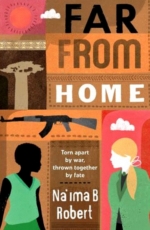
Far From Home by Na'ima B. Robert (Book Excerpt)

‘A prince is a slave when far from his kingdom.’
- Shona proverb

Chapter 4

News

The next morning, we all slept later than usual. The heat of the morning had risen and I woke up hot and damp, my mouth parched. My dreams had been very vivid: I was looking for Nhamo in a burning field, and I could hear the sound of angry men’s voices. Then I saw him walking ahead of me and I ran after him, the earth around me black and smoking, but I could not catch up with him. The smoke began to sting my eyes and I couldn’t see any more and when I woke up, my eyes were sticky with unshed tears.

I sat up slowly and held my head in my hands. What had the dream meant? Unlike Amai, I never dreamed in prophecies, seeing the shape of things to come. My dreams were always simple, forgettable, and I hardly ever thought about them in daylight. But that morning, I could still smell the acrid smoke, the prickle of burnt grass under my feet, the black soot coating my legs. And my voice as I called Nhamo to wait, wait, wait for me. He had not looked back, walking on until he disappeared from view, leaving me rubbing my eyes with soot-covered hands, making black marks on my face.

I reached over and soothed my burning throat with water from a calabash. I could hear Amai sweeping outside so I washed my face and quickly went out to greet her, remembering for the first time that we had not spoken about her dream.

But, as I rushed outside, I heard the sound of a bicycle bell and rubber tyres, soft on the fine dust of the footpath. Amai heard it too and straightened up, her hand on her back, one hand shading her eyes from the mid-morning sun that played in the dust.

It was a messenger from Fort Victoria.

“Mukai, mukai!” he shouted, his voice scarring the sleeping silence of the homestead.
Amai glared at him. “Is this any way to greet people?” She clicked her teeth. “Some people have forgotten everything their parents taught them!”

The young man was suddenly ashamed. He lowered his head and said, humbly, “Please forgive me, Amai, I forgot myself. I have a message for the chief from the District Commissioner.”

Amai motioned to me and I went to fetch my father who was sleeping at MaiZiyanai’s house. Standing outside at a respectful distance, I called to him.

“Baba! There is a man here to see you. He says he has a message from Fort Victoria.” Baba emerged, tucking his waist wrapper round his middle. He nodded his thanks and walked slowly to where the young man was waiting, in the middle of the clearing.

The man seemed to have remembered his manners and clapped his hands respectfully, greeting Baba formally as was our custom.

“The District Commissioner says that you are to assemble the members of the dare council here this afternoon. He has very important news and he does not want to have to go to each homestead one by one. So you must all come here and he will speak to you all.”

My father looked offended. “What is it he wants to talk about? Can he not speak to me in private? I am, after all, the leader of my people. If he has anything to tell them, he can tell them through me.”

The messenger looked embarrassed. “Actually,” he confided, “it was the deputy commissioner who insisted that he speak to all of you. Baas Thompson wanted to discuss with you privately but Baas Watson said, no, these native chiefs must not get too big for their boots. He wants to speak to the people directly.”

“So, Watson is coming, not Thompson?”

The messenger nodded.

I felt a sense of foreboding when I heard that. I could not understand why. I could see that Baba was not pleased, as he pressed his lips together and clenched his fists around his walking stick. But what could he do?

“Tell him they will be here,” he said at last, and his shoulders sagged, just a little. The messenger thanked him gratefully and ran back to pick up his bicycle. Baba turned and looked at us and the other wives and children that had assembled.

“We should prepare ourselves for bad news,” he said shortly and turned to MaiZiyanai, suddenly irritated. “What are you waiting for, woman?” he barked. “Prepare my tea and my bath!” And he stalked off, to brood over the meeting to come.


That afternoon, the men began arriving from the surrounding homesteads. My brothers had all been sent to call the men of the other households, to summon them to the meeting with Deputy District Commissioner Watson. So they came, feet dusty, beads and snuff bags slung over their shoulders, shiny, worn jackets that were too small or too old to be worn by their sons in town, dusty overalls hanging from the bony shoulders of old men with grizzled beards.

They all sat in a circle, some lost in their own thoughts, others talking with their friends in low voices, all of them waiting, waiting. My heart skipped a beat when I saw Babamunini sitting with Farai and Nhamo. But they were lost in conversation and I could not catch Nhamo’s eye.

We, the women of the chief’s family, waited inside, hoping to hear the news from Fort Victoria. The heat of the morning had ripened and swelled in the homestead, stifling the breeze, the air thick and heavy with the smell of wood smoke and wild flowers.

Then they came, Deputy District Commissioner Ian Watson and his Africans from Fort Victoria. The younger children stared open-mouthed at the glinting steel of the guns the men carried, at the hardness in their faces. These were not our uncles, these men, though their skin was like ours. They were from the west of the country and they spoke Ndebele, rather than Karanga. It was a favourite tactic of the white man: to divide and rule. In our case, they had succeeded, for we knew from bitter experience that the guns they carried were not just for show.

In the middle of the group of men came Deputy Commissioner Watson, his blue eyes cold, his hands behind his back, holding his sjambok. He nodded towards my father who came forward to greet him. But Watson simply stared at Baba’s outstretched hand, then looked away. I understood immediately: Watson was one of those varungu who did not touch Africans. Everything about him - his imperious stare, the straightness of his back, the way he carried his head – spoke of arrogance and entitlement, and my nerves bristled to see my father snubbed by someone less than half his age.

Then, he cleared his throat and spoke, his voice clear and formal, as if he was making a speech he had rehearsed. “It is my duty to inform you that, as you already know, a law was passed by the government in Salisbury in 1952. That law was the Native Land Husbandry Act and, until now, the government has been slow to implement it. All that has changed, thanks to more dedicated administrators becoming involved.” He looked around at us all and smiled briefly. “Now, you all know that the government in Rhodesia has tried to treat you people fairly and has looked after you. In fact, the Native Land Husbandry Act is yet another way of the government showing how much it cares for you Africans. This law will allow you to learn how to farm properly, instead of keeping too many cattle, cutting down all the trees and allowing the soil to become eroded. The white men who will be given this land you are on now will work for the good of the country: they will plant tobacco and cotton – cash crops – and they will keep cattle for export...”

Suddenly, he stopped and looked at the sea of uncomprehending faces. His face flushed red and his blue eyes flashed as he snarled, “Waste of bloody time, talking to you people. I told Thompson but he doesn’t listen...”

His African assistant turned to him. “Should I translate, sir?”

“Ag, don’t bother, Petros!” Watson barked. “What’s the bloody point? They won’t understand, no matter how much you try and explain. These people haven’t got a bloody clue – can’t you see from their faces? Just tell them that they’ve got two weeks to get their things together – the trucks will be here to move them to the Native Reserve. They’ll soon learn that there is more to life than dancing and drinking beer, eh?” He chuckled and Petros laughed with him, showing all his teeth.

He then turned to face the men who had been following his exchange with Watson and, with exaggerated formality, he began to give a speech of his own: “Baas Watson came here today to tell you that this land is going to be reallocated, according to the Native Land Husbandry Act of 1952. You have two weeks to arrange your affairs before the trucks come to take you and your families to your new homes.”

Baba simply stared at Petros, disbelieving, but Babamunini and the other elders were not so calm. Several of them began to shout out in protest, waving their sticks at Petros, spitting on the ground. Amai and I exchanged glances. What was going to happen?

“New home?” Babamunini barked, his brow creased, his eyes angry. “What do you mean ‘new home’? This is our land and the land of our forefathers! This is where our ancestors are buried, where we have sown our seeds, where we raise our children. This is our home – and it has always been!”

Another elder spat in the dust and glared at Petros: “We will not let our land be taken from us! How dare you come here with such abominable speech?” The other men all nodded in agreement. An older man, his mouth showing more gaps than teeth, struck the ground with his walking stick and said, “How can they tell us to leave our own land? Do the spirits not expect us to honour them here? If we leave, who will perform the rituals to honour the dead? No! To abandon our ancestral lands would be to invite the wrath of the ancestors upon us!”

Petros dropped his official demeanor and looked contemptuously at them all. “Do you really think that your talk of spirits and ancestors will change the white man’s mind? Look, you are on good land here and the varungu want it for their farms, to grow cash crops like tobacco and cotton...” The men’s voices rose again, almost drowning Petros’ voice but he continued, ignoring them. “And they have prepared another place for you to live just south of here. You have two weeks to pack up and leave.”

This resulted in a frenzy of shouts, accusations and choked insults and curses. The group of men seethed, as one body, arms raised, fists clenched. Several carried deadly knobkerries, others held their walking sticks in both hands. I saw the glint of a panga blade. The African messengers from Fort Victoria looked at each other fearfully, unsure of what to do. Watson frowned, and shouted at Petros.

“Hey, keep these natives under control, man!” But it was too late for Petros to attempt to assert himself. Garikai and Nhamo’s uncle had grabbed hold of his khaki shirt and were shaking him, shouting and slapping his face while he looked wildly around for help. But the others were also under attack as the angry men went to vent their anger on the colonial servants. The homestead echoed with raised voices, and scuffling feet churned the dust. For a moment, it looked as if the men were going to take the messengers and beat them senseless.

Out of the corner of my eye, I saw Babamunini and Nhamo start towards DC Watson. He saw them coming and, with a curl of his lip, he reached down and drew out his gun.


Chapter 5

Confrontation

Deputy Commissioner Watson fired his gun into the air, once, twice, then pointed it at Babamunini. Immediately, the men fell back and the messengers, panting with fear and sweating, managed to free themselves and reach for their own weapons. The metal of their guns glinted in the sunlight as they pointed them at my father, my uncle, my brothers, my beloved.

Petros, coughing and spluttering, struggled to retain his dignity. Watson gave him a hard look and barked, “That’s why you’ll never get that promotion, Petros. You can’t even control your own people! You’re useless, man, pathetic!”

Petros turned to glare at the villagers. “You are all mad if you think you will get away with this! I am a representative of the Queen of England! And I will be respected!”

But Babamunini would not back down. Breathless, his chest glistening with sweat, he snarled, “You are nothing but a sell-out! A despised servant who cannot even share a cup with the white baas you love so much!”

Petros ignored him and turned to Baba at last and said, with exaggerated courtesy, “May I remind you that you are a servant of Her Majesty, the Queen of England and that, by law, you must obey our orders?” His voice took a vicious turn. “And remember, the only reason that you are still the chief is that your grandfather made the wise decision to comply with the varungu. Otherwise, you would have found yourself with nothing: no wives, no children, and no land. Not even a badza to call your own. Remember that! You owe your allegiance to the queen in England now, the one who pays for your snuff.”

All eyes were on Baba, waiting for him to tell this bush pig to go back to his mother’s womb, to assert his authority. But Baba just stood there, clenching and unclenching his fists, and the moment passed. A movement rippled through the group of men; a slumping of shoulders, a heaving of chests, a shaking of heads. And a new look of disdain flooded their eyes when they looked at Baba, as emasculated as a castrated bull. The defiant, aggressive atmosphere dissipated as my father withstood the disappointed looks of the people he was meant to lead.

Petros savoured the moment, and then turned away, scornfully. “You may go, all of you!” he called out. “And remember, two weeks and the trucks will be here to take you to your new home.”

The men filed away, murmuring, casting sidelong glances at Baba as they left. Soon, the clearing was almost empty. Only Baba, Babamunini, my brothers and Nhamo remained, as Watson, Petros and the others prepared to leave.

Watson, putting away his revolver turned to Petros and said, “Hey, Petros, remember what I told you back in Fort Vic? I want a girl to come and work for me at my house...”

Just then, my youngest brother ran out into the clearing. I hissed for him to come back but he ignored me. I had no choice but to come out of Amai’s house after him. I felt all eyes on me as I scooped him up into my arms. Then I saw Petros grin and point towards me.

“What about her, baas? Would you like someone like her? She’s pretty, eh?”

Watson turned his head, then walked back to get a better look. His eyes swept over me, from my braided hair to my bare feet. Then, he smiled, a smile that reminded me of the crocodiles that wait for their prey on the riverbank, waiting, half-asleep, until a mother turns her back. It made my blood rush to my face. And then, to make it worse, he actually spoke to me.

“Come here, girl,” he called, beckoning me.

I faltered and looked at Baba. Did I really have to do what this white man said? Baba nodded his head stiffly and his eyelid flickered. He put out his hand and I walked to where he was standing. Protectively, he put his hand lightly on my shoulder. But by now, Watson was loping towards me, his eyes never leaving my face. Baba drew me closer to him as Watson approached but, without so much as looking at my father, Watson simply tapped him lightly on the chest with his sjambok – a silent command to stand back. Baba had no choice but to obey and leave me, his eldest daughter, standing in the middle of his homestead, being looked over by a white baas from Fort Victoria.

He stood close to me, so close that I could smell him: sweat, leather and ironed cotton. I could see the white hairs on his forearms, the cut on his left knee. Arms, knees, legs; this was all I saw because my head was bowed low with shame. He walked slowly round me, his eyes burning trails all over my body. He felt my upper arm for muscles. He slapped my right thigh with his sjambok. Inside, I was screaming. My heart rebelled against the indignity of being poked and prodded, like a cow that was about to be sold. And so, even though my face burned with shame and tears stung my eyes, I forced myself to look up, to look my tormentor in the face, to look into his blue, blue eyes with my blazing brown ones. I caught his eye as he stopped in front of me. He was so close that I could smell the tobacco on his breath. There was a moment of surprise that I dared to look him in the eyes, then the hint of a smile. A cruel, sadistic smile.

“I see we have a feisty one here, Petros,” he laughed, casting a glance over his shoulder. “But do you think she’s feistier than my horse, Milly?”

And, with that, he grabbed hold of my lower jaw and pulled my mouth open, pushing his grimy thumb between my teeth, feeling my molars.

I could taste him.

My stomach lurched and I gagged, tears stinging my eyes.

I did not think.

I bit down. Hard.

Watson let out a cry of pain and surprise and brought his other hand, balled into a fist, crashing into the side of my face. The pain exploded, muscle, bone, and I let go of his thumb and fell to the ground, gagging and retching. That was when Amai appeared. She flew to me, screaming, holding her protruding belly, and put her arms around me as I lay there in the dirt.

Just then, there was a strangled cry and Nhamo, all glowing skin, taut muscle and eyes spitting fire, leapt forward and slammed into Watson, knocking him off his feet. In seconds, he was straddling him in the dust, shouting curses, his huge fist exploding in Watson’s face. Blood spurted from Watson’s nose and soon, Nhamo’s hands were slippery with it.

It took a few moments for Watson’s men to realise what was happening and react. Some of them held their weapons up at Babamunini and my father while two of them tried to haul Nhamo off Watson who writhed, bleeding, on the floor of our homestead. But two men were not enough. After all, this was Nhamo, the boy who had defeated a lion single-handedly. Soon, five of them were struggling to hold Nhamo so that Watson could get up, staggering and holding his nose. I recoiled at the sight of him. His face was covered in blood and his blue, blue eyes glittered with rage as he pointed at Nhamo.

“You’ll regret this, you bloody kaffir!” he screamed, his voice twisted with pain and fury. “You dare to touch me? You dare to touch me?” And, forgetting about his own broken nose, he drew his fist back and swung it at Nhamo’s face. We heard the crack. We saw the blood. I watched as Nhamo struggled to free his arms, fought to protect his head, tried to duck the blows. But it was no good. All we could do was stand there and watch while Watson punched Nhamo again and again, all the while calling him a ‘filthy munt’ and a ‘dirty kaffir’. We could do nothing because the guns were ready now, the sticks raised.

When Watson was done, he hauled himself away, panting, sweat running down his face, mingling with his blood, holding a handkerchief to his nose. He made a motion with his hands and, in a flash, Petros and the other Africans fell on Nhamo with their sjamboks, those whips that draw blood on first contact. Blood spurted like flame lilies from Nhamo’s back as the men turned him over and whipped him again and again and again.

It was Petros who began the kicking. First his back, then his belly and then his head, as Nhamo tried to curl his body, as in his mother’s womb, to protect himself from their blows. Watson mopped his forehead and licked his bleeding lips as he watched, a look of satisfaction on his face.

Seeing my beloved like that, so helpless, I could not hold myself and I sprang forward and tried to pull one of the men off him but he knocked me down with one sweep of his arm.

Eventually, Watson called the men off. They gave Nhamo one last kick and then hauled him up to drag him to the waiting vehicle. I scrambled to my feet and ran towards them.

“Where are you taking him?” I screamed at them. The guns turned on me immediately and, although I felt a cold wave of dread wash over me, my blood was too hot. I pushed them aside and ran to Nhamo. His eyes were swollen shut, his face a mess of crimson blood and purple bruises.

“Nhamo, Nhamo,” I moaned, “what have they done to you, moyo wangu?”

Watson swung himself up into his truck and glared at the terrified huddle of men, women and children who had, by now, gathered in the homestead to witness the scene. He waved his gun over their heads.

“Let this be a warning to you all!” he shouted. “Don’t get any silly ideas in your heads. You have two weeks to get your things and move to the reserve. My men will be here to make sure that everything goes smoothly.”

“But where are you taking him?” I screamed again, hot tears searing my cheeks, my face contorted with anguish.

“As for this one, don’t you worry about him,” muttered Watson grimly. “He has assaulted one of Her Majesty’s officers. We’ll teach him a lesson he’ll never forget...” Then he turned the key and the engine roared. “Come on, you boys, checha, hurry up!”

And then they were gone, carrying my brave, foolish, bleeding Nhamo with them.

When they had gone, all that could be heard was the worried murmuring of the men, women and children and the high keening cry that came from my throat, as I sank to the ground and sat rocking, my hands pressed to the red soil where Nhamo’s blood bloomed in dark patches. I felt as if my heart had been torn in two.

I could not look in Baba’s eyes that night.


Far From Home is an excerpt from a book by Na'ima B. Robert.
(Frances Lincoln Children's Books, Aug, 2011)

Copyright © Na'ima B. Robert 2011.


Na’ima B. Robert, born Thando Nomhle McLaren, is descended from Scottish Highlanders on her father’s side and the Zulu people on her mother’s side. She was brought up in Harare, Zimbabwe, and graduated from the University of London. Her books include the popular From my sisters' lips, and teen novels, From Somalia, with love and Boy vs. Girl. Na'ima has also been published in The Times, The Observer and The Muslim Weekly as well as several online publications, including AfricaBe.com. She is married to a Ghanaian and has four children.


10 July 2011

You Smile by Chika Onyenezi

You awake, and it’s the twenty first century on the calendar, but your location reads eighteenth century in its wild attitude and lifestyle. You look around and are still in the same country; a country that contradicts your very existence and buries your goals before they are hatched. You smile; though there is nothing to smile about. You are young in age but your heart is much older. You have endured the mishmash education of the body while your soul feels uneducated and yearning to be comforted. Your soul wants to hope for a job and a fat salary paid to you every month for a luxurious lifestyle, but your body knows it is farfetched. You hope, and hope, because you are used to hope and live in a land of hope. You are a young graduate from the university in your local. You hope to have a job that will let you drive a car and walk boldly on the street like every successful young man in the city.

This story has been selected for the annual StoryTime anthology African Roar 2012, please go to the African Roar site for more info.


You Smile was written by Chika Onyenezi.

Copyright © Chika Onyenezi 2011.


Chika OnyeneziChika Onyenezi was born on the second December 1986, he is an editor at AuthorMe a popular international literary magazine and currently studying Computer Science at Caritas University, Enugu.

He is a peace activist, and a member of Green Lake Peace Network founded by Dr. Claude Shema-Rutagwengwa.

He is currently in Nigeria and writes from the city of Owerri and Enugu and blogs at Grey Scale


03 July 2011

The Revenge of Kamalaza Mayele by Vukani G. Nyirenda

“When is that mambo of ours going to open the partying season,” grumbled Kamalaza Mayele while at Chitenje; the men’s gathering place. “We ground our millet three weeks ago, more millet is in the storage bins, and still the women’s grinding stones lie unused.”

This story has been selected for the annual StoryTime anthology African Roar 2012, please go to the African Roar site for more info.


The Revenge of Kamalaza Mayele was written by Vukani G. Nyirenda.

Copyright © Vukani G. Nyirenda 2011.


Vukani G. Nyirenda is a freelance writer. A specialist in children’s folktales, though he also writes for adults. After graduating with a Doctor of Social Welfare degree from the University of California, Los Angeles (UCLA), he worked in his home country, Zambia, as university lecturer, administrator and civil servant. He is also a graduate of Long Ridge Writers Group, the Institute of Children’s Literature and member of the Society of Children’s Book Writers and Illustrators. He has published two children’s illustrated books and his short stories have appeared in several children’s magazines and newspapers. He lives in Los Angeles with his three grown up children and five grandchildren. He can be reached at vukanin26(at)gmail(dot)com


StoryTime: Weekly Fiction by African Writers.
All works published in StoryTime are
Copyrighted ©.
All rights reserved.